The Magnolia State · 2026 Guide
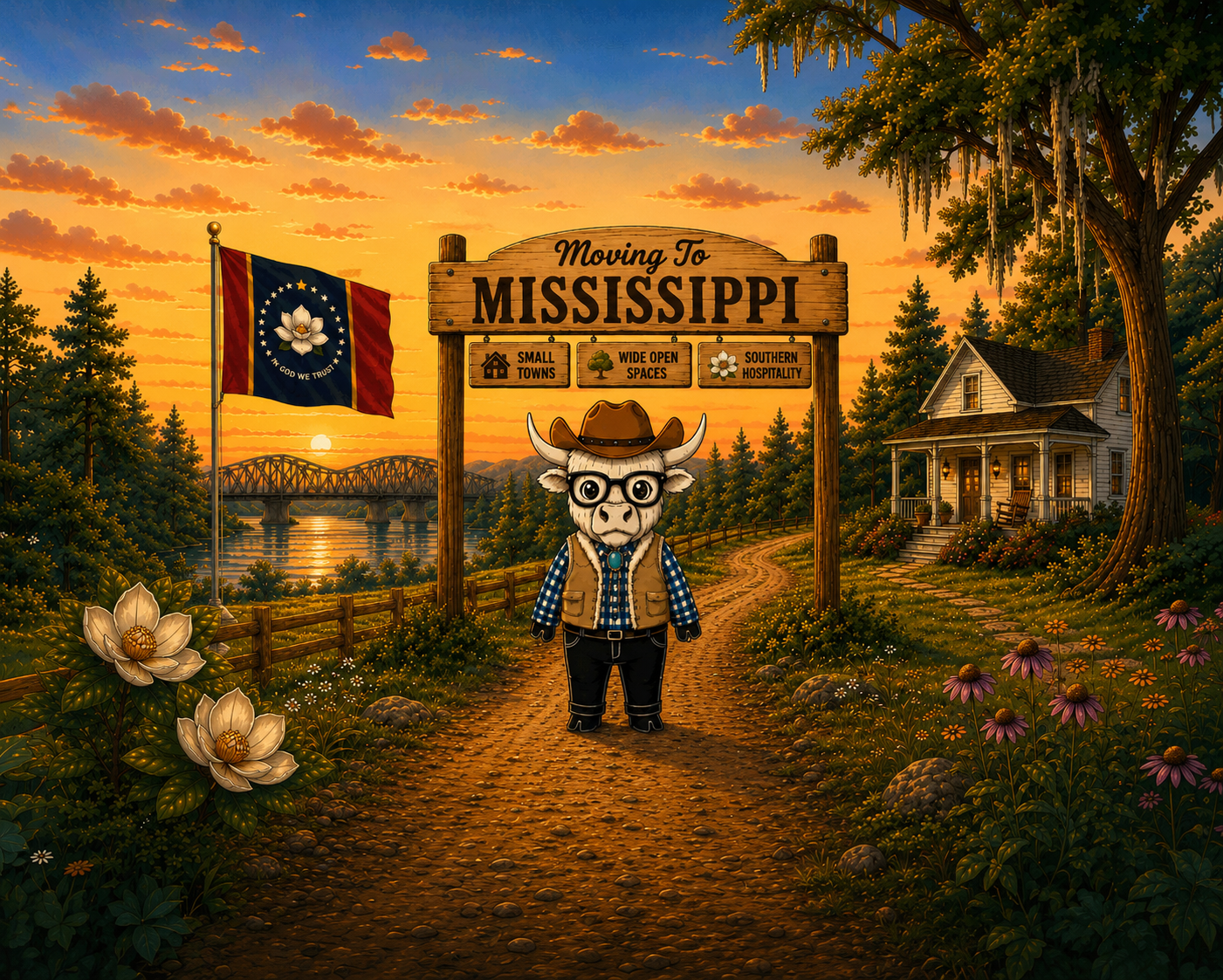
Benji the Highland Cow showing his Mississippi pride at the Welcome to Mississippi sign — moving truck, Magnolia flowers, Mississippi flag and red pickup in the background

MOVING TO MISSISSIPPI. the honest, GROUND-LEVEL GUIDE.

Cost of living, land prices, property taxes, the seven regions, climate, culture, and what life actually looks like on the ground — from a family-owned land company that works here.

Authored by Seth & Bryce Drehle-Ewan, Co-Founders · About Debrosland
Browse · Mississippi

Ready to see what's on the market?

Active Mississippi listings, plus owner-financed options for qualified buyers. Browse what's available — or send what you're looking for.

Active listings updated weekly
Owner-financed options for qualified buyers
Brothers who love Mississippi

At a glance.

Mississippi by the numbers, in plain English.

The honest snapshot. Population, prices, taxes, climate — the figures you'd want before you start looking at houses or land. Sources cited under each stat so you can verify or dig deeper.

Population

~2.94M

35th-most populous state. Roughly half rural, half urban.

Cost-of-living index

83.3

Lowest in the U.S. National average = 100.

Median home price

~$263K

Compared to a national median above $440K.

Median land price

$5,434/ac

Statewide median listing. Remote tracts run far lower.

Property tax rate

~0.6%

Effective rate. Among the lowest in the country.

Climate

Subtropical

Hot summers, mild winters, 50+ inches of rain.

Sources: U.S. Census Bureau and Britannica (population); Council for Community and Economic Research C2ER Cost of Living Index 2025 annual average (cost index, housing index); Houzeo / ConsumerAffairs (median home price); Land.com via LandBoss (median land price per acre); Tax Foundation and propertytaxbystate.com (effective property tax rate); Mississippi State University Department of Geosciences (climate). Verify current figures before relying on them for major decisions.

Why people come.

The honest reasons folks move to Mississippi.

Mississippi isn't for everyone — but for the people it fits, it really fits. Here's what we hear most often from the buyers we talk to, and what the numbers back up.

01

It is genuinely cheap to live here

Mississippi has the lowest cost-of-living index in the nation at 83.3 (C2ER 2025). Housing is the driver — the state's housing index sits near 66, the lowest in the country. A dollar earned here stretches roughly 15% further than the national average.

02

Property taxes are among the lowest in America

The effective property tax rate runs roughly 0.58% to 0.74% statewide depending on the source, well under the national average near 0.92%. The median Mississippi homeowner pays about $1,215 a year. There's no estate or inheritance tax.

03

Land is still affordable and abundant

The statewide median listing price for Mississippi land is around $5,434 an acre (Land.com), with remote, wooded, or marginal tracts available well under $1,000 an acre in some counties. There are roughly 3.5 million acres of farmland in the state.

04

Winters are mild, growing seasons are long

Humid subtropical climate. The ground rarely freezes, cold spells seldom last more than three or four days, and the growing season is nearly year-round on the Gulf Coast. Summers are hot and humid — that's the trade-off.

05

It is a hunting, fishing, and outdoors state

More than 50 Wildlife Management Areas open to public hunting (MDWFP), world-class waterfowl in the Delta, healthy whitetail and turkey populations statewide, and miles of river, lake, and Gulf access. Lease rates average roughly $15 to $20 an acre.

06

Retirement income gets a friendly tax treatment

Mississippi does not tax Social Security, qualifying pension income, or qualifying retirement plan distributions. The state's homestead exemption gives full state property tax relief to honorably discharged totally disabled veterans and to surviving spouses of service members who died on active duty.

Cost of living.

A dollar in Mississippi goes further than almost anywhere else.

The most-cited cost-of-living dataset in the U.S. is the C2ER Cost of Living Index, where 100 is the national average. Mississippi sits at 83.3 — the lowest score in the country. Housing is the biggest reason. Here's how the categories break down.

According to the C2ER index (2025 annual average), Mississippi's overall cost of living is roughly 16.7% below the national average. The Bureau of Economic Analysis's Regional Price Parity index puts Mississippi at 87.0 — about 13% below the national baseline. Either way, Mississippi consistently ranks first or near the top of the cheapest-states list.

Where the savings show up most: housing (index near 66 on C2ER, the lowest in the nation) and rent. Recent data puts the average Mississippi rent at around $988 versus a national median above $1,600. Utilities and transportation also run below average. Healthcare costs are lower in absolute terms but rural access is a real consideration — see the things to know section.

A practical way to think about it: to maintain the purchasing power of a $100,000 national-average salary, you only need roughly $87,000 in Mississippi (BEA RPP). Or flipped: $100,000 earned here has the purchasing power of about $115,000 at the national average.

Category Mississippi National avg Notes
Overall index (C2ER)83.3100.0Cheapest state in the U.S.
Housing index (C2ER)~66100.0Lowest in the nation
Median home price~$263K~$447KLess than 60% of national median
Median 2BR rent~$988~$1,639Roughly 40% lower
Gas (per gallon)~$2.69~$3.20Among the lowest in the country
Grocery (weekly per household)~$291~$270Slightly above national average
Property tax (effective)~0.58–0.74%~0.92%Varies by county; see breakdown below

Sources: Council for Community and Economic Research C2ER Cost of Living Index 2025 Annual Average; U.S. Bureau of Economic Analysis Regional Price Parities 2024; Houzeo and ConsumerAffairs (median home price); Apartments.com (rent); ConsumerAffairs and U.S. Energy Information Administration (gas); U.S. Census Bureau American Community Survey (grocery, property tax); Tax Foundation (effective property tax rate). Figures reflect the most recent published data at time of writing. Verify current numbers before relying on them.

The seven Mississippis.

One state, seven distinct stories.

Mississippi is not one thing. The Delta, the Hill Country, the Golden Triangle, the Capital Region, the Natchez Bluffs, the Pine Belt, and the Gulf Coast each have their own terrain, their own economy, and their own version of southern. Where you land in Mississippi changes the daily experience more than most people expect.

Benji in the Mississippi Delta — flat farmland, cotton, and cypress country

Region 01 · Northwest

The Delta

Flat, fertile, and famous. The Delta runs from Memphis south to Vicksburg between the Mississippi and Yazoo Rivers — some of the deepest topsoil in North America, where cotton, soybeans, corn, rice, and catfish operations dominate. It is also arguably the best wintering habitat for mallards in North America, which is why Greenville and Yazoo City are legendary among waterfowlers.

  • Best for: farming, waterfowl hunting, ag investment, blues history
  • Anchor towns: Greenville, Cleveland, Greenwood, Clarksdale
  • Vibe: wide-open, rural, working agricultural country
Benji in the Hill Country — rolling hardwood hills of north Mississippi

Region 02 · North

Hill Country

Rolling hardwood hills, mixed forest, and the highest ground in the state (Woodall Mountain — all 807 feet of it). Strong whitetail and turkey hunting, plenty of mixed-use recreational land, and the Memphis-adjacent suburbs of DeSoto County that have become Mississippi's fastest-growing relocation destination. Holly Springs National Forest, Sardis Lake, and Grenada Lake all sit here.

  • Best for: deer hunting, recreational land, lake access, Memphis commuters
  • Anchor towns: Southaven, Olive Branch, Tupelo, Oxford, Corinth
  • Vibe: suburban-to-rural, mature trees, four mild seasons
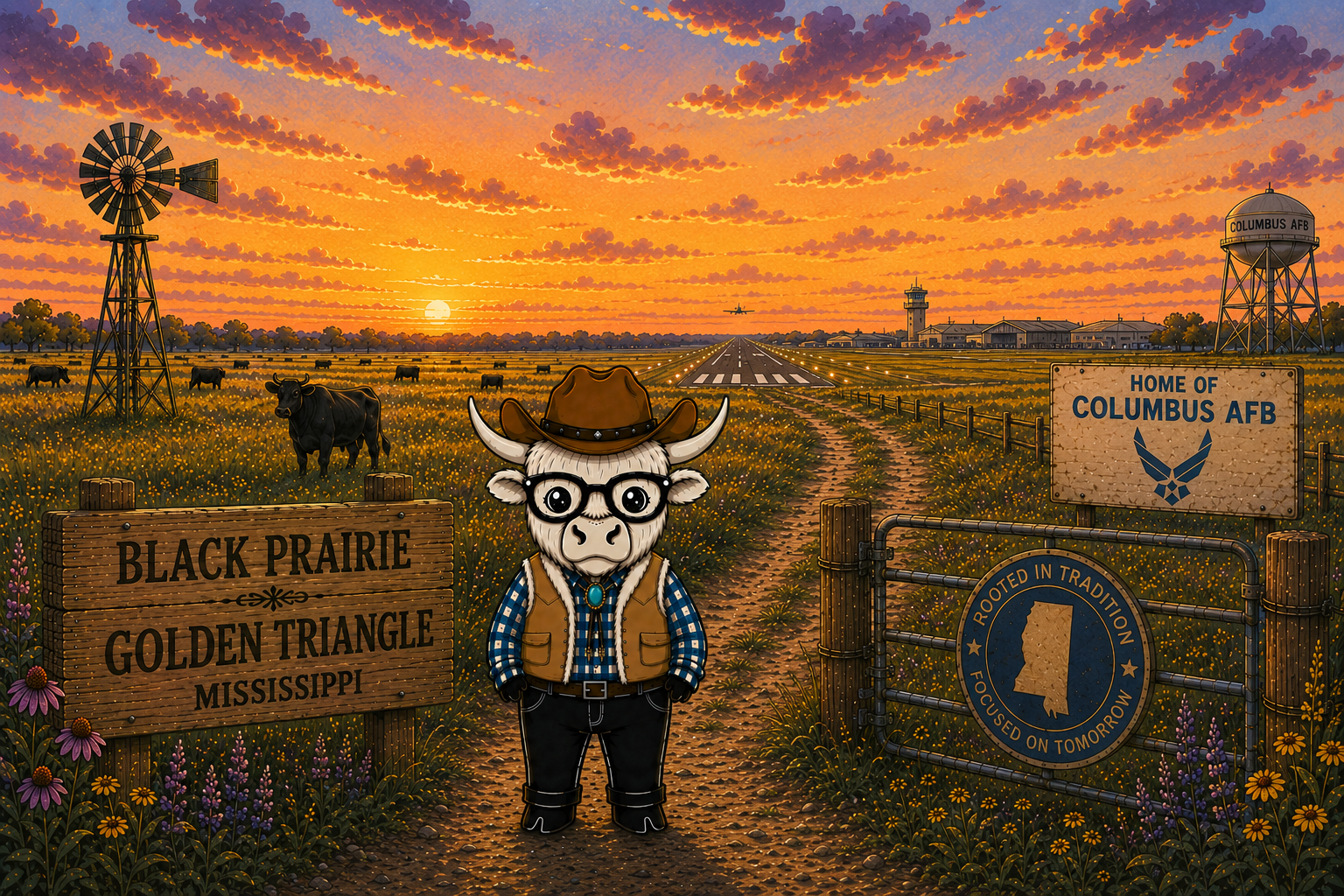
Benji in the Golden Triangle — Black Prairie country of east Mississippi

Region 03 · East

Golden Triangle

The Black Prairie country — the trio of Starkville, Columbus, and West Point. Rich black-belt soils that grow cattle and crops, Mississippi State University as the regional anchor, and a manufacturing corridor that includes Severstal steel and a growing Steel Dynamics presence. Lush, productive, and quietly one of Mississippi's strongest small-metro economies.

  • Best for: college-town life, manufacturing jobs, cattle, mixed-use land
  • Anchor towns: Starkville, Columbus, West Point, Macon
  • Vibe: college-and-industry, productive farmland, settled small-town south
Benji in central Mississippi — the Capital Region and Reservoir country

Region 04 · Central

The Capital Region

Jackson, Madison, and Rankin Counties form Mississippi's largest metro at nearly 600,000 people — the state's job center and government hub. Madison and Rankin Counties have some of the best schools in Mississippi and are popular relocation destinations for suburban amenities. The Ross Barnett Reservoir provides 33,000 acres of lake recreation right outside town. Hinds County (which contains the City of Jackson) carries higher property taxes and a tougher municipal reputation than the surrounding suburbs.

  • Best for: jobs, schools, lake recreation, suburban relocation
  • Anchor towns: Jackson, Madison, Brandon, Ridgeland, Flowood, Pearl
  • Vibe: capital-city metro with suburban polish and reservoir access
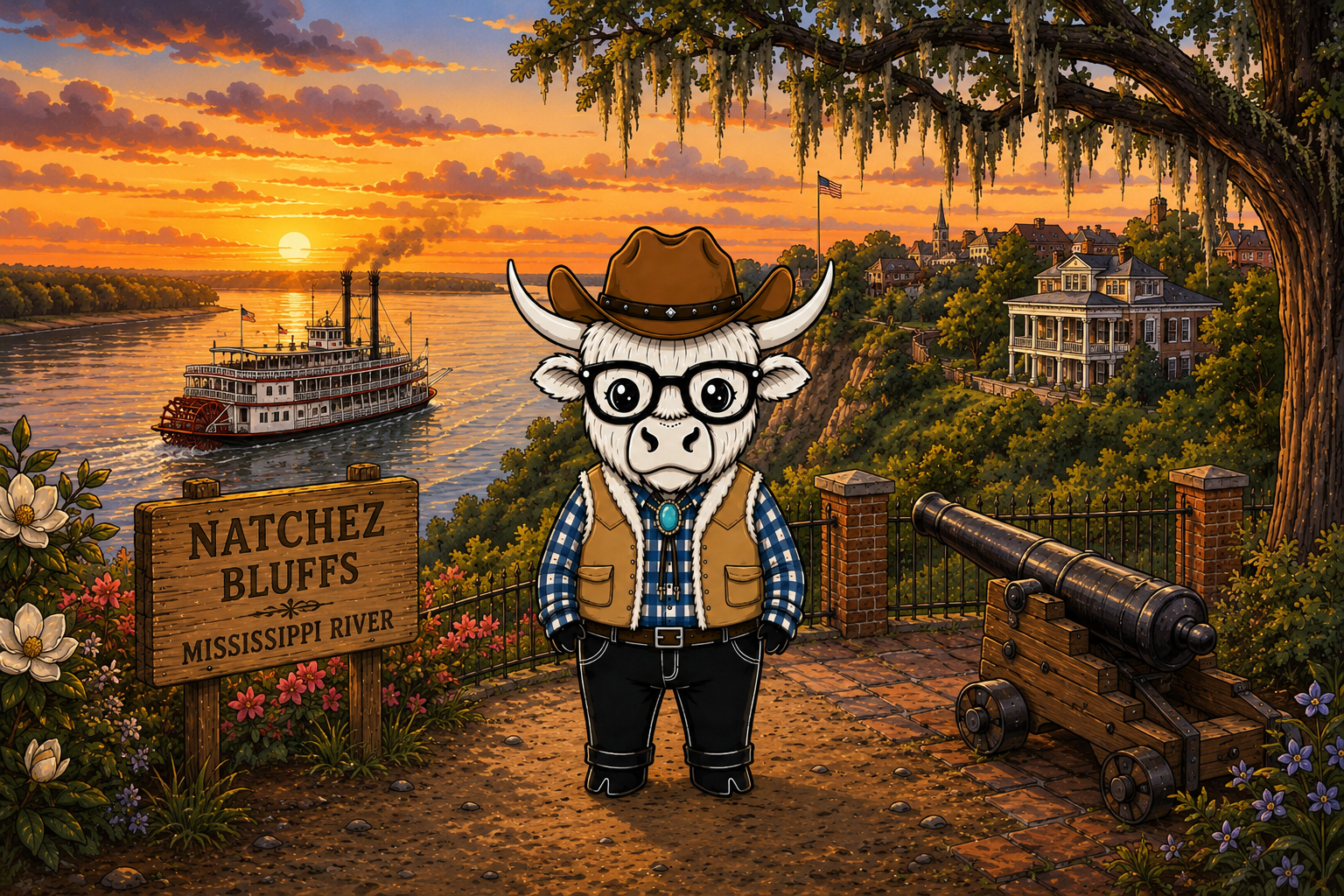
Benji at the Natchez Bluffs — historic river country along the Mississippi

Region 05 · Southwest

Natchez Bluffs

The river country. Sloping loess bluffs above the Mississippi River, the antebellum architecture of downtown Natchez, the Natchez Trace Parkway running north toward Nashville, and a slower-paced corner of the state with deep history. Hunting is excellent — the Homochitto National Forest covers nearly 200,000 acres of public timber and game land here.

  • Best for: history lovers, hunting on national forest land, river access
  • Anchor towns: Natchez, Vicksburg, McComb, Brookhaven
  • Vibe: historic, slower, river-influenced, deeply southern
Benji in the Pine Belt — south central Mississippi timber country

Region 06 · South Central

The Pine Belt

The forestry heart of Mississippi. Tall longleaf and loblolly pine plantations on rolling ground, sawmills, paper mills, and a deep timber-economy tradition. Buyers here underwrite land based on the age of the stand, the site index (soil productivity for growing trees), and the haul distance to the nearest mill. Hattiesburg is the regional hub. Camp Shelby sits nearby, and the famed Hometown HGTV show is filmed in Laurel.

  • Best for: timber investment, hunting, affordable rural homesites
  • Anchor towns: Hattiesburg, Laurel, Meridian, Petal, Picayune
  • Vibe: piney woods, working-forest country, small-town south
Benji on the Mississippi Gulf Coast — barrier islands and coastal lifestyle

Region 07 · South

The Gulf Coast

Mississippi's most varied stretch — barrier islands, white-sand beaches, marsh, casino economy, and the Ingalls shipyard at Pascagoula building Navy vessels. The growing season here is essentially year-round. The trade-off is hurricane exposure: eight hurricanes have struck the Mississippi coast since 1895, including Camille and Katrina. Wind insurance is a real line item on coastal budgets, and the further inland you go, the cheaper it gets.

  • Best for: beach access, casino/hospitality work, Navy/shipyard jobs, fishing
  • Anchor towns: Biloxi, Gulfport, Bay St. Louis, Ocean Springs, Pascagoula
  • Vibe: coastal, tourist-influenced, slower-paced than Florida

Climate & geography.

Hot, humid, wet, mild — year after year.

Mississippi sits squarely in the humid subtropical climate zone, sandwiched between the North American continental landmass and the Gulf of Mexico. The result is predictable in broad strokes: long hot summers, short mild winters, abundant rain spread fairly evenly through the year.

Summers run from May through September with daily highs typically in the low 90s and dew points routinely in the upper 70s — that "you-walk-outside-and-the-air-hits-you" kind of humidity. Air conditioning runs heavily, but the trade-off shows up in winter electric bills, which are low.

Winters are short and mild. January highs average in the mid-50s; lows in the low 30s. Cold snaps happen but rarely last more than three or four days, and the ground rarely freezes. Snow is rare statewide and almost never sticks long.

Annual rainfall averages more than 50 inches statewide — among the wettest states in the U.S. — and is spread fairly evenly through the year rather than concentrated in one season. Severe weather is part of the package: locally violent thunderstorms an average of about 60 days a year, tornadoes mostly in spring, and Gulf Coast hurricane exposure from late summer into fall.

The whole state is low-lying. The highest point is Woodall Mountain at 807 feet. Most of the topography is gentle — rolling hills in the north and east, true flatland in the Delta, gentle uplands in the Pine Belt, coastal lowland on the Gulf.

Outdoor lifestyle.

Hunting, fishing, camping, and land out your back door.

A genuine reason people relocate to Mississippi: the outdoors here is not an afterthought. Hunting and fishing are part of the cultural fabric — woven into how kids grow up, how families spend weekends, and what landowners do with their acres.

The Mississippi Department of Wildlife, Fisheries, and Parks (MDWFP) manages more than 50 Wildlife Management Areas across the state — public land open to hunters with a license. Combined with national forests, national wildlife refuges, and U.S. Army Corps of Engineers areas around the major lakes, Mississippi has more accessible hunting, fishing, and recreation ground than most southern states.

Benji hunting in Mississippi

Hunting

Whitetail, turkey & waterfowl

Archery in October, gun season late November through January for whitetail (one buck per day, three per season). Spring gobbler runs mid-March through May. The Delta is world-class for ducks and geese in the Mississippi Flyway. More than 50 Wildlife Management Areas open to public hunting statewide.

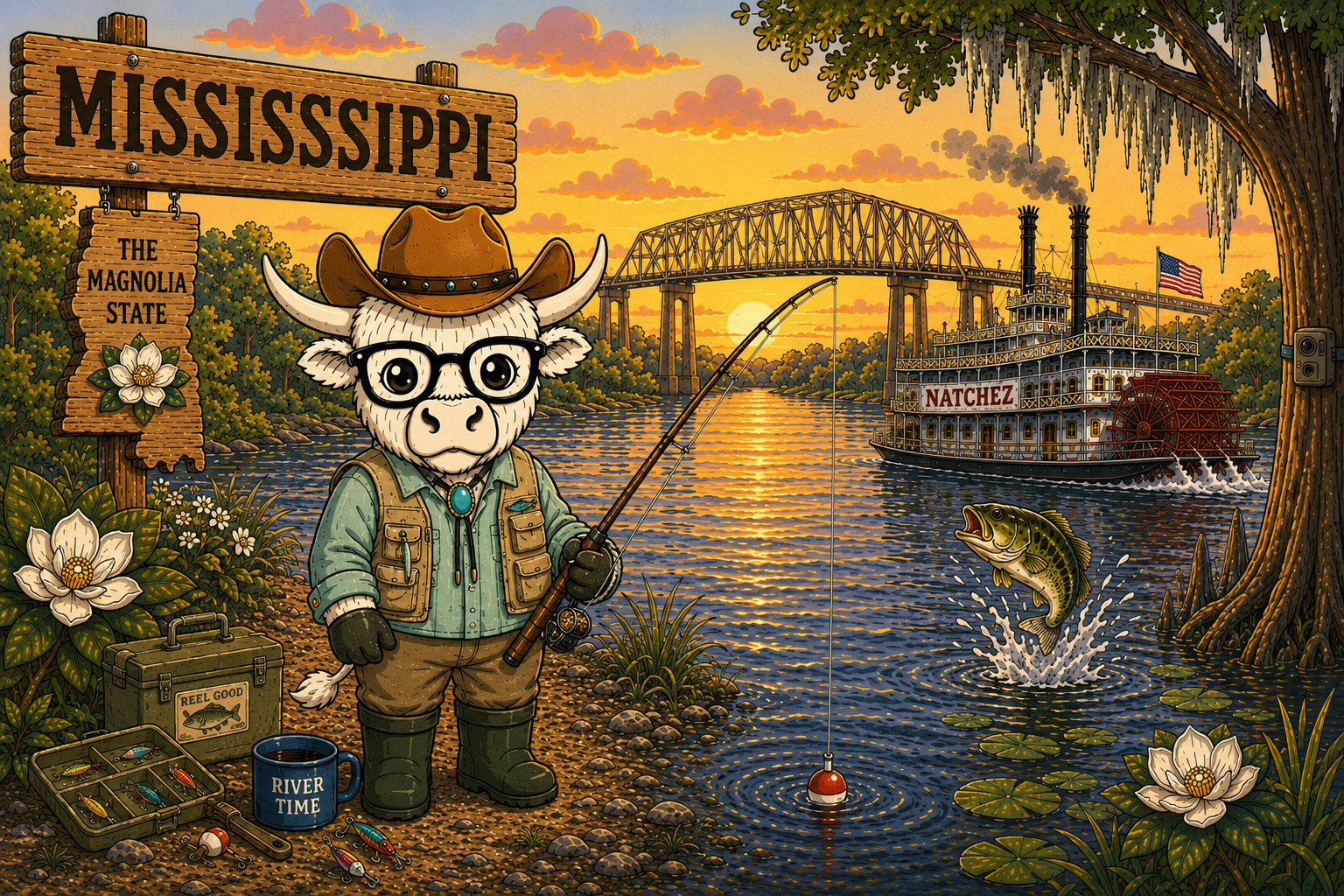
Benji fishing in Mississippi

Fishing

Catfish, bass & saltwater

Mississippi is the nation's top farm-raised catfish producer. Largemouth and spotted bass on every major reservoir — Sardis, Grenada, Ross Barnett, Pickwick. Saltwater redfish, speckled trout, and flounder on the Gulf Coast. Fishing licenses are inexpensive and resident-friendly.

Benji camping in Mississippi

Camping

State parks & national forests

Twenty-five state parks, four national forests covering more than 1.2 million acres of public ground, and a long camping season that runs nearly year-round on the Coast. Tishomingo, Tombigbee, and Roosevelt State Parks are perennial favorites. Cabin rentals, RV sites, primitive — take your pick.

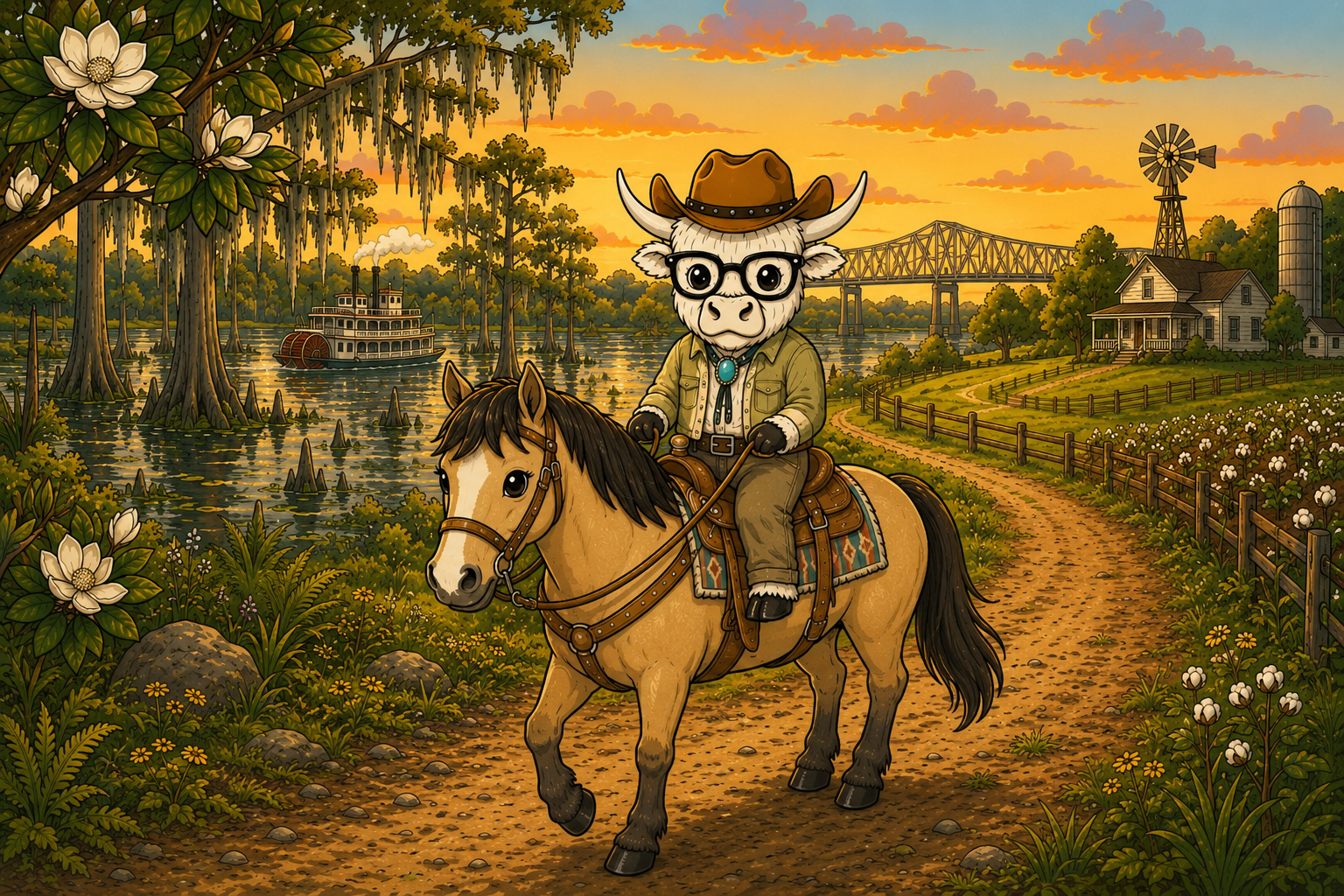
Benji horseback riding in Mississippi

Recreation

Horseback, ATV & trails

Horseback riding on the Natchez Trace, ATV trails through national forest, and miles of multi-use paths. A culture of using your own land too — for food plots, riding pastures, and weekend cabins. Hunting leases average $15–20 per acre statewide, which makes mid-size tracts genuinely income-producing.

Source: Mississippi Department of Wildlife, Fisheries, and Parks (2025–2026 regulations) and MS State Parks. Season dates, bag limits, and access rules change — verify at mdwfp.com and mdwfp.com/parks-destinations before planning a trip.

Working & economy.

What people do for a living down here.

Mississippi's economy leans on agriculture, manufacturing, shipbuilding, forestry, healthcare, and Gulf Coast casino tourism. It is not a tech-corridor state, but remote work has opened doors here the same way it has across the rural South — and the cost-of-living math gets very favorable for portable income.

Agriculture

The foundation. Top U.S. producer of farm-raised catfish, major producer of cotton, soybeans, corn, and sweet potatoes. Roughly 3.5 million acres of farmland. Poultry processing is the state's largest agricultural industry by value.

Shipbuilding & defense

Ingalls Shipbuilding in Pascagoula builds Navy destroyers, amphibious assault ships, and Coast Guard cutters — one of the largest employers on the Gulf Coast. Camp Shelby near Hattiesburg supports National Guard training.

Manufacturing

Toyota's Blue Springs plant assembles Corollas. Nissan operates in Canton. Both have pulled supplier networks into the state, particularly in the north-central and Jackson-metro corridors.

Timber & forestry

The Pine Belt is the heart of Mississippi forestry. Loblolly and longleaf pine plantations, hardwood bottomlands, sawmills, and pulp mills support a working-forest economy that goes back generations.

Casino gaming & hospitality

Gulf Coast and riverboat casinos generate significant revenue and employment in Biloxi, Gulfport, Tunica, and along the Mississippi River. Hospitality and tourism build on the coast and on historic-site corridors.

Healthcare & education

University of Mississippi Medical Center anchors the state's healthcare system in Jackson. Mississippi State, Ole Miss, the University of Southern Mississippi, and several smaller institutions are large regional employers.

Mississippi culture.

Three things woven into daily life.

If you move to Mississippi and want to understand the place quickly, pay attention to three things: what people eat, what they do on Friday nights, and what they do on Sunday mornings. The state's culture lives at the intersection of those three.

Mississippi food — Delta hot tamales, fried catfish, and comeback sauce

Food

Tamales, catfish, and a plate of whatever the table says

Mississippi cooking pulls from every direction. The Delta has hot tamales — a tradition that came up through migrant labor in the early 1900s and stayed put. The state is the nation's top farm-raised catfish producer, and a fish fry is still a legitimate way to gather a hundred people on a Saturday afternoon.

South Mississippi runs heavy on Gulf seafood — shrimp, oysters, redfish, gumbo. Soul food traditions run deep statewide: fried chicken, collards, cornbread, butter beans, and sweet tea by the gallon. Jackson is the home of comeback sauce. Almost every small town has a barbecue place worth driving for.

  • Try first: Delta hot tamales, fried catfish, comeback sauce
  • Statewide staple: sweet tea, served unsweetened on request only
  • Holiday classic: Mississippi Mud Pie, pecan pie, banana pudding
Mississippi football — Friday night lights and SEC Saturdays

Football

Friday nights are community theater.

Football is not a hobby here — it's civic infrastructure. High school football draws towns together on Friday nights; college football carves the state in half on Saturdays. The Egg Bowl (Ole Miss vs. Mississippi State, played since 1901) is one of the oldest and most heated rivalries in college sports.

The list of NFL stars who came up here is absurd for a state this size: Brett Favre, Jerry Rice, Walter Payton, Steve McNair, Archie Manning (and sons Peyton, Eli, and Cooper). Jackson State, an HBCU, has produced its own legends. Southern Miss has a long Conference USA tradition.

  • Big three: Ole Miss Rebels, MSU Bulldogs, Southern Miss Golden Eagles
  • Stadium town: Starkville on a fall Saturday is worth the drive
  • Don't skip: a Friday night high school game in any small town
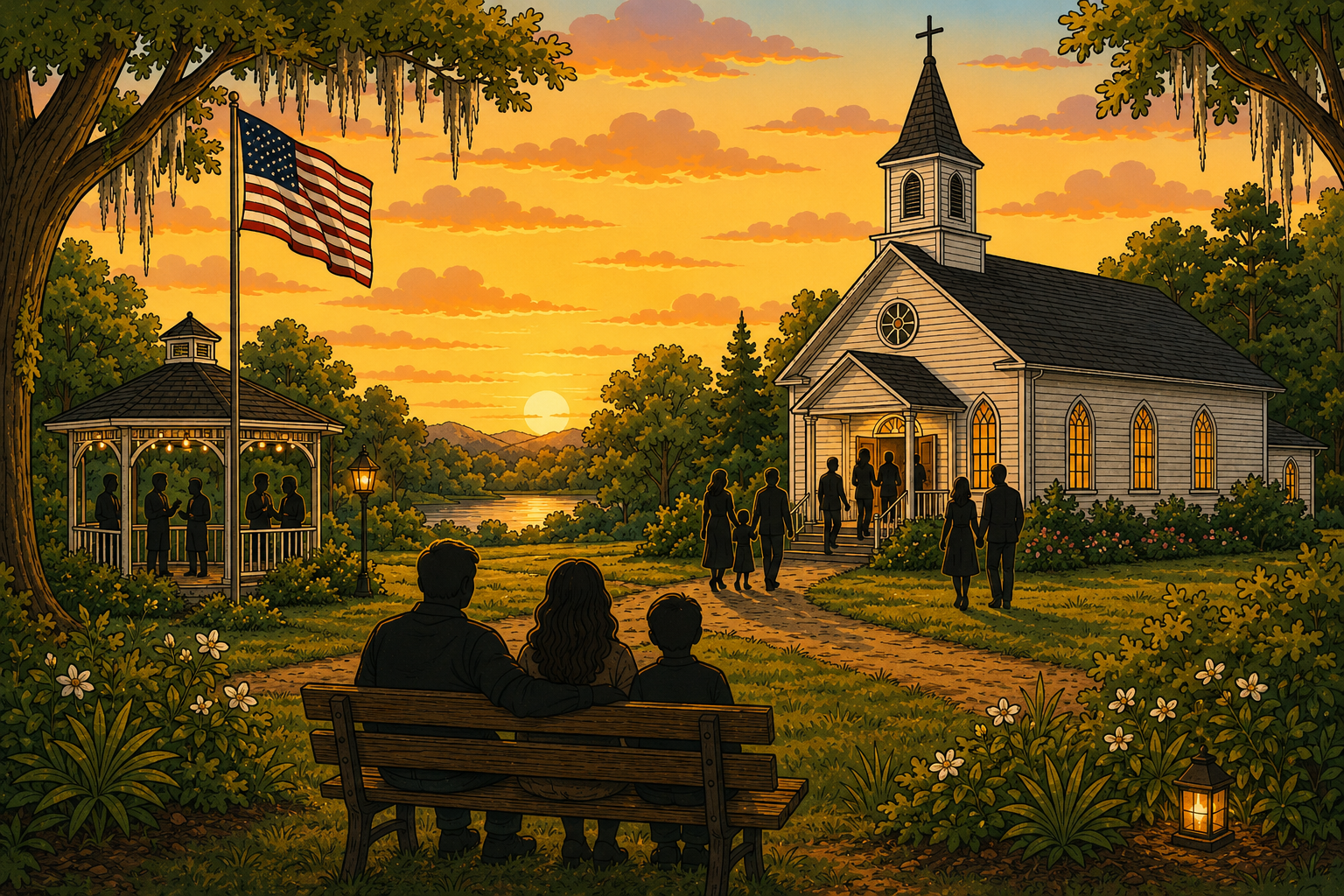
Mississippi religion — small-town church on a Sunday morning

Religion

Sunday mornings are where the week resets.

Mississippi is one of the most religious states in the U.S. Pew Research consistently ranks it #1 or #2 for self-identified religiosity. The Southern Baptist Convention is the largest denomination by a wide margin; Methodist, Pentecostal, and non-denominational churches are common. Catholic communities run strong along the Gulf Coast.

Church here is civic infrastructure as much as spiritual practice — the place where neighbors meet neighbors, where casseroles arrive after a death in the family, and where small towns coordinate. You don't have to participate to live here well, but understanding the role church plays in community life makes the place a lot easier to read.

  • Dominant tradition: Protestant Christian, Southern Baptist plurality
  • Sunday norm: many small businesses still close Sunday morning
  • Coast variant: French Catholic heritage strong in Biloxi / Bay St. Louis

Things to know.

The honest trade-offs nobody puts on a tourism site.

If we only told you the good parts, we wouldn't be doing our job. Here's the stuff to weigh seriously before signing anything. None of these are deal-breakers for the right person — but they are real.

Healthcare access varies — sometimes a lot

Mississippi ranks at or near the bottom of national healthcare-access rankings. Urban metros (Jackson, Tupelo, Hattiesburg, the Gulf Coast) have solid hospitals and specialists. Rural counties can be 30 to 60 minutes from the nearest full-service emergency room. If you have ongoing medical needs, map out access before you pick a county.

School quality is a county-by-county question

Public school quality in Mississippi varies dramatically by district. Madison and Rankin Counties (Jackson metro), DeSoto County (north), and several Gulf Coast districts consistently rank well. Other rural districts struggle. Research the specific district — not the state average — before you buy.

Wages run below the national average

Median household income in Mississippi is roughly $56,000 versus a national figure above $67,000 (U.S. Census). The cheaper cost of living offsets some of this, but if you depend on local wages — not portable income or savings — the math is more nuanced than the headline cost-of-living number suggests.

Hurricane and wind insurance on the Gulf Coast

If you buy on or near the Coast, factor in windstorm insurance separately from a standard homeowners policy. Eight hurricanes have hit Mississippi's coast since 1895, including Camille and Katrina. The further inland you go, the cheaper insurance becomes — by a lot.

Tornado season is real

Spring brings serious tornado risk statewide — not just the Coast. A storm shelter or interior safe room is worth the investment on rural land, and homeowner's policies vary in how they cover wind damage. The state averages about 60 thunderstorm days per year.

Rural connectivity has improved, but verify

Fiber and rural broadband have expanded fast in Mississippi over the last five years, but coverage still varies by county and even by road. If you work remotely, confirm the actual available speeds at the parcel address — not the carrier's general coverage map — before you commit.

All 82 counties.

How to buy land in every Mississippi county.

A guide for each of Mississippi's 82 counties — what the land is like, what it tends to cost, what to watch for during diligence, and how the buying process works locally. Grouped by region so you can find your spot.

All 82 counties · regional grouping is editorial — some counties straddle boundaries.

The map.

Mississippi, from above.

Pan, zoom, and explore. Satellite view gives the clearest sense of the actual ground — Delta cropland, Pine Belt forests, the Mississippi River corridor, and the barrier islands of the Gulf Coast.

MISSISSIPPI 32.7°N · 89.7°W · ~48,430 sq mi · 82 counties

FAQ.

Mississippi questions, answered honestly.

The questions we get most often from buyers thinking about Mississippi. If yours isn't here, get in touch and someone on our team will answer it directly.

Is Mississippi a good place to live?

Mississippi is a strong fit for people who value affordability, mild winters, land access, hunting and fishing culture, and a slower pace of life. The state has the lowest cost of living in the U.S. by most measures, low property taxes, and abundant rural land. The trade-offs are healthcare access in rural counties, school quality that varies sharply by district, hurricane exposure on the Gulf Coast, and lower wages than the national average. For retirees, remote workers, hunters, and homesteaders, the math often works very well. For careers that depend on local wages or specialty healthcare, look harder.

What is the cost of living in Mississippi compared to other states?

Mississippi consistently ranks as the cheapest or one of the cheapest states in the U.S. for cost of living. The C2ER Cost of Living Index puts Mississippi at 83.3, roughly 17% below the national average of 100. Housing is the biggest driver — the housing index sits near 66, the lowest in the nation. Median home prices in Mississippi run around $263,000 to $276,000 versus a national median above $440,000. Utilities, transportation, and healthcare also run below average. Groceries are roughly comparable to the national average.

Where is the best place to live in Mississippi?

It depends on what you want. DeSoto County in the north (just south of Memphis) and Madison and Rankin Counties in the Jackson metro are the top relocation destinations for jobs, schools, and amenities. The Pine Belt and Hill Country counties offer lower prices, more land, and rural lifestyle. The Gulf Coast — Hancock, Harrison, and Jackson Counties — suits people who want beach access, casinos, and a coastal vibe, with the trade-off of hurricane exposure and higher insurance.

If you're moving for cost-of-living plus suburban amenities, look at Madison, Rankin, or DeSoto. If you want acreage and rural quiet, look at the Hill Country or Pine Belt. If you want the water, look at the Coast.

Is Mississippi a good place to retire?

Mississippi is one of the more retirement-friendly states for taxes. The state does not tax Social Security, qualifying pension income, or qualifying retirement plan distributions. Property taxes are among the lowest in the country, and the homestead exemption gives full state property tax relief to honorably discharged totally disabled veterans and to surviving spouses of service members who died on active duty.

The trade-offs are rural healthcare access and humid summers. For retirees who want a low tax burden, mild winters, and the option to own meaningful acreage, Mississippi works. For retirees who need frequent specialty medical care, location matters — stay closer to Jackson, Tupelo, Hattiesburg, or the Gulf Coast.

How much does land cost in Mississippi?

The statewide median listing price for Mississippi land is approximately $5,434 per acre according to Land.com. Mississippi State University Extension reports irrigated cropland averaged $5,754 per acre and non-irrigated cropland averaged $4,628 per acre in reported 2023–25 sales. Remote, wooded, or marginal tracts can still be found under $1,000 per acre in some counties. Recreational, waterfront, and Delta waterfowl tracts command significant premiums.

Price per acre also depends heavily on parcel size: smaller starter tracts (1–5 acres) often cost 30–100% more per acre than larger tracts in the same county.

What are property taxes like in Mississippi?

Mississippi's effective property tax rate ranges from about 0.58% to 0.74% statewide depending on the source and county, well below the national average of roughly 0.92%. The median homeowner pays roughly $1,215 per year.

Rates vary by county: DeSoto and Rankin Counties sit around 0.55% to 0.56%, while Hinds County (which contains the City of Jackson) is higher at about 0.83%. The state has no estate tax and no inheritance tax. Owner-occupied homes are assessed at 10% of true value rather than market value, which keeps bills low.

What is the climate like in Mississippi?

Mississippi has a humid subtropical climate — long, hot summers and short, mild winters. July highs average in the low 90s with high humidity. January temperatures typically range from the low 30s to mid-50s, with cold snaps usually lasting only three or four days. Snow is rare statewide.

Annual rainfall averages more than 50 inches — among the wettest states in the U.S. — and is spread fairly evenly through the year. The growing season is long and on the Gulf Coast is nearly year-round. The state is exposed to hurricanes on the coast and to spring tornadoes statewide.

What is it like to own land in Mississippi?

Land ownership is woven into Mississippi life. The state has roughly 3.5 million acres of farmland, more than 50 Wildlife Management Areas open to public hunting, and a long tradition of recreational, timber, and agricultural land use. Property taxes are low, the growing season is long, and large tracts are easy to find compared to most of the country.

Many landowners use their acreage for a mix of hunting, timber income, food plots, a cabin or homesite, and long-term family land. Owner-financing is common in the rural land market here. Browse current Mississippi land listings for a sense of what's available right now.

Can I hunt on my own land in Mississippi?

Yes. Mississippi resident landowners and their immediate family members are generally exempt from purchasing a state hunting license to hunt their own qualifying land, though they must still follow all season dates, bag limits, weapon restrictions, and harvest reporting requirements set by the Mississippi Department of Wildlife, Fisheries, and Parks (MDWFP). Non-resident landowners typically still need a license.

Food plots, mineral licks, and tree stands on your own land are common practice. The state allows hunting deer over bait on private land in much of Mississippi with specific rules, but rules vary by zone and species and they do change — always verify current MDWFP regulations at mdwfp.com before the season.

Is Mississippi welcoming to newcomers?

Yes — Mississippi is generally one of the friendlier states for newcomers, and "southern hospitality" is not a cliché here. The way you experience that depends on where you land. Small towns operate on relationships, and showing up at the local diner, the hardware store, the high school football game, and (if it fits you) a church on Sunday will plug you into the community faster than anything else. Newcomers who lean in tend to feel at home quickly. Newcomers who stay private and transactional will find the place polite but distant.

Larger metros — Jackson, the Gulf Coast, the Memphis-adjacent suburbs of DeSoto County — are more transient and easier to blend into without making a project of it. Some communities have visible newcomer pipelines (retirees on the Coast, remote workers in DeSoto, college families in Starkville and Oxford). If you're moving rural, expect a slower social integration but a deeper one — and don't be surprised when someone shows up with a casserole the week you move in.

The brothers behind Debrosland.

Howdy from Seth & Bryce.

We're not a national listing service. We're two brothers who run a family-owned land company — and Mississippi has been one of our two home markets from the very beginning.

Seth and Bryce in front of the Welcome to Mississippi sign on the side of the highway
Welcome to Mississippi
Seth and Bryce in front of the Corinth, Mississippi mural
Corinth, MS
Seth and Bryce at the Scotsman General Store in Laurel, Mississippi, with the famous truck from HGTV's Hometown
Scotsman General Store · Laurel, MS

We started Debrosland in 2017 — out of Timnath, Colorado, but with Mississippi as one of our two home markets today. Our family farm in Colorado goes back to the 1800s, and that's where we learned that land is a long game. We started Debrosland because we wanted to share land ownership with folks beyond our family — to make the door wider, not narrower.

We work this state with love and passion. So far, we've spent time in Laurel (yes, that Laurel from Home Town), Corinth, and the northern part of Mississippi — with more trips already on the horizon. When we tell you about a Mississippi parcel, we have genuine love for the future owner to build a life full of beautiful memories on that dirt.

That love shows up in the details. Owner-financed options for folks who'd rather skip the bank. Honest descriptions of every parcel — the strengths, the trade-offs, and the questions worth asking. Plain-English paperwork at closing. A phone answered by one of us — not a junior, not a chatbot, not an outsourced rep. Small things, but they add up to whether you can trust the people you're buying land from.

If you're thinking Mississippi, we'd love to talk. No pressure, no scripts. Just a real conversation about what you're looking for and whether we can help you find it.

Co-Founders · Debrosland

Read our full story →
Benji, Debrosland's Highland Cow brand ambassador

"Land has a way of pulling folks home — and Mississippi has more than her share to go around."

Highland Cow & Brand Ambassador

Talk to a real human.

Got Mississippi questions we didn't answer?

Someone on our team will get back to you the same day. No pressure, no spam, no scripted pitch — just a straight conversation about what you're looking for in Mississippi and whether we can help.