EVERY
WAY
to finance
YOUR
AMERICAN
LAND.

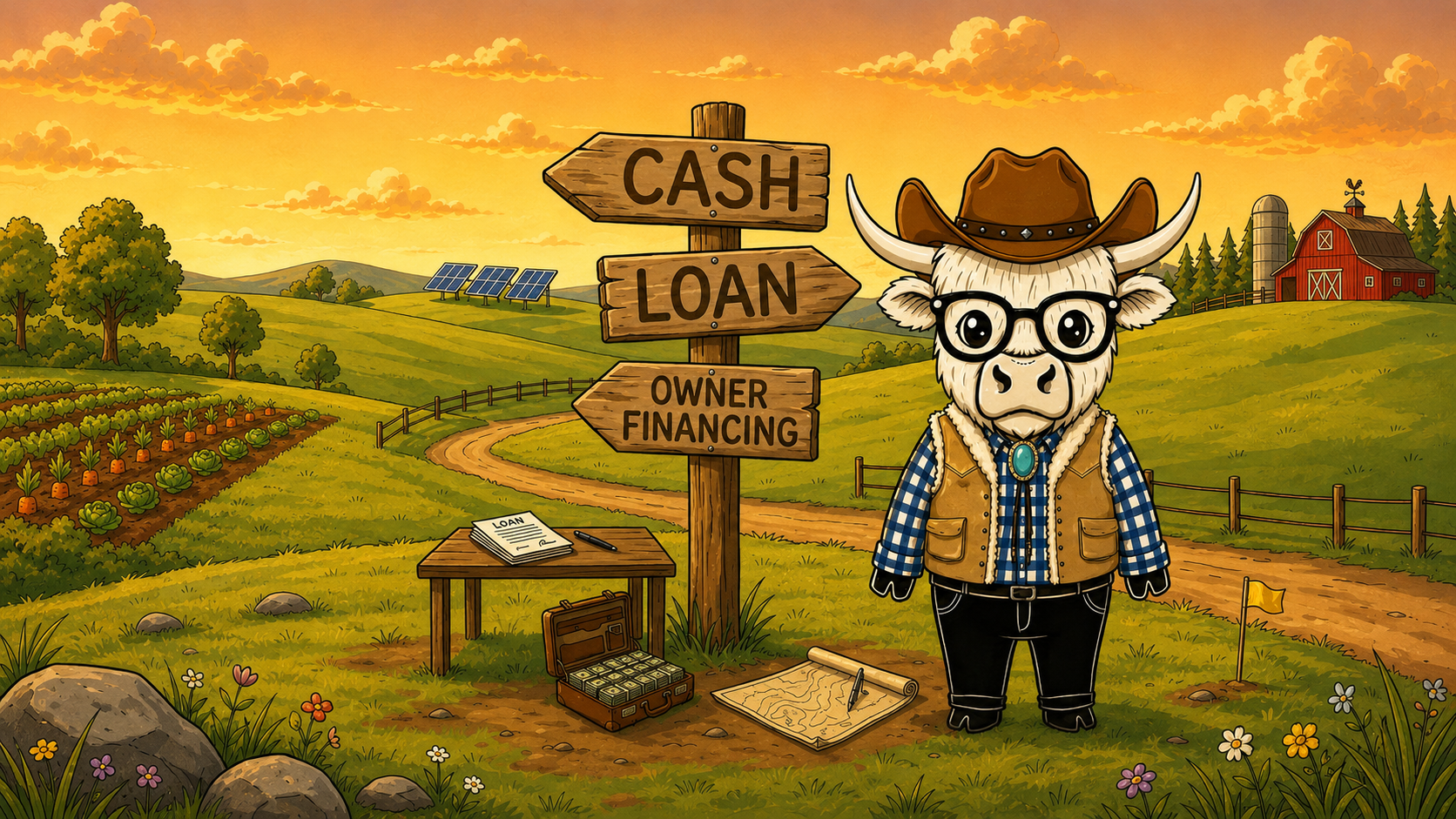
Benji, the Highland cow and brand ambassador of Debrosland

“Paying for land is simpler than folks make it sound. Three paths, plain English, no gotchas. I'll walk you through what's different about each one — then you decide.”

Highland Cow & Brand Ambassador
Path One

Pay cash.

“Fastest path to ownership, biggest discount, least paperwork. If you've got the funds, this is the move.”

Cash is the simplest financing on earth — because it isn't financing. You wire funds to the closing attorney or title company, the deed gets transferred, and the land is yours. No interest. No monthly payments. No credit check. No lien.

Because cash sellers carry zero risk for us, cash buyers typically get our best pricing. Every listing on the site has a cash price that's meaningfully lower than what you'd pay with owner financing or via a bank loan.

Who this is for: buyers with the full purchase amount liquid and available. Most of our listings run between $5,000 and $80,000, so cash isn't out of reach for a lot of buyers — especially on smaller parcels.

Down payment
100% at close
Interest rate
None
Typical close time
7–30 days avg ~14
Credit check
Never
Closing handled by
Real estate attorney or title company
Closing costs
$1,000–$1,500 approx

The trade-off is liquidity. Putting cash into a parcel means that your hard earned cash is tied up in land until you sell it or use it as collateral. Land is a long-term asset, not a liquid one.

If cash works for you, it's the cleanest path. If it doesn't, keep scrolling — the next two sections cover what to do.

Browse All Listings
Path Two

Bank or credit union.

“The traditional path. More paperwork than a cash deal, but it exists — you just have to know where to look.”

Most big national banks don't lend on vacant land. Land loans are a specialty product, and banks that offer them treat them differently than home mortgages: higher down payment, shorter terms, higher rates. That's not a scheme — it's because raw land is harder to appraise and carries more risk for the lender than a house on a foundation.

Where to actually look.

Local community banks and credit unions. The ones in your county or the county where the land sits. They know the area, they know the land values, and they're far more likely to do a land loan than Chase or Bank of America. Walk in, ask about their land loan program.

Farm Credit System lenders. Farm Credit is a nationwide cooperative that specializes in rural land and ag financing. Not just for working farms — many of their member banks lend on rural recreational, homestead, and raw land too. Find your local branch at farmcredit.com.

USDA Rural Development. For qualifying buyers in designated rural areas buying land to build a primary residence, USDA offers loan programs with favorable terms — including zero-down construction options (more on that below). Details at rd.usda.gov.

What to expect from a typical land loan.

Down payment
Varies
Interest rate
Varies by lender and credit — typically 1–2 points above home mortgage rates
Term length
Up to 30 years; 10–20 most common
Close in
30–90 days
Payment schedule
Monthly, amortized fixed payment
Qualification
Credit required, with income verification
Early payoff
Varies by lender

Building on the land? Construction loans.

If your plan is to buy the land and break ground on a home in the same timeframe, a construction loan is what you're looking for. These are specialty products that roll land purchase and construction costs together, and most convert into a permanent mortgage once the build is done — often called “one-time close” or “construction-to-perm.”

The main types:

Federal-backed

FHA Construction

Low down payment (3.5% with credit 580+, or 10% with 500–579). One-time close rolling land + build + mortgage into a single loan. Must be a primary residence. Good for first-time builders with moderate credit.

Veterans only

VA Construction

$0 down for eligible veterans, active-duty service members, and surviving spouses. No PMI. Same one-time-close structure. Primary residence required. Competitive rates.

Rural areas

USDA Construction

$0 down for buyers in qualifying rural areas. Income limits apply based on location and household size. Primary residence required. Credit 640+ preferred. A lot of our parcels qualify.

Conventional

Land + Construction

Bank-issued, 20–25% down, strong credit required (680+). Interest-only during construction, converts to a fixed-rate mortgage when the build is complete. Fewer program restrictions than FHA/VA/USDA.

Construction loans are a specialty product. Big national banks rarely write them — check local community banks, credit unions, or Farm Credit System lenders. Most will want your builder licensed and the plans approved before they'll commit.

In Mississippi? Two lenders we send buyers to.

We don't have exclusive partnerships or co-branded deals — but we've sent plenty of our buyers to both of these, and they've been treated right. If you're buying a Debrosland parcel in MS, these are worth a call.

Land · Manufactured Home · Construction

Cadence Bank

Tupelo, Mississippi

Works two ways depending on what fits: (1) pay us cash for the parcel and get a separate land loan, construction loan, or manufactured-home loan from Cadence, or (2) have Cadence write one loan that covers both the land and the home or MH together — one closing, one payment. Cadence has closed plenty of our deals and knows the MS land market.

cadencebank.com

Want an introduction? Call us first and we'll point you toward the right contact.

Land + Manufactured Home

Southern Housing of Tupelo

Tupelo, Mississippi

The turnkey path. Southern Housing handles everything under one roof: the manufactured home itself, financing for the land and home as a single package, and installation on the parcel. Best if you want one company coordinating every moving part.

southernhousing.net

Want an introduction? Call us first and we'll point you toward the right contact.

Outside Mississippi: the playbook is the same — talk to local community banks, credit unions, USDA Rural Development, Farm Credit affiliates, or specialty manufactured-home dealers in your state. Local lenders know the local land market better than the national chains.

If the bank process feels like too much friction, or if you don't want your credit pulled, keep reading — that's exactly what our owner financing solves.

Path Three · Ours

Debrosland owner financing.

“We're the seller. We're the lender. One signature, one payment, one company for the life of the loan. No middleman.”

Owner financing — sometimes called seller financing or a land contract — is when the seller of the property is also the lender. Instead of a bank handing the seller a lump sum and then collecting from you, you pay the seller directly over time.

We've been doing this since 2017. It's simple, it's fast, and it solves the biggest friction point of bank loans: qualifying.

What makes ours different

No credit pull. No income verification. No underwriting committee. If you can cover the down payment and the closing, you qualify.

That's not marketing language — that's the actual bar. We don't run credit, we don't ask for tax returns, we don't care about your debt-to-income ratio. The parcel is the collateral. If you stop paying, we reclaim it. That's the whole risk model, and it means we can say yes to buyers that a bank would turn down.

That said, we do have an honest conversation about the payment before we write up paperwork. Not a credit pull. Not pay stubs or tax returns. Just a plain talk about whether the monthly number is comfortable for your situation. It's a check for both of us — we'd rather know up front if the payment is a stretch than run into trouble six months in.

Heads up · If you want to build

Debrosland owner financing doesn't cover construction. If building is your real goal, a bank construction loan (or construction-to-permanent loan) is the better path — those products are designed specifically for buyers who plan to build during the loan term. Use the Bank path above, and ask lenders about construction financing.

Here's the honest version of how we set terms. 20% down is the typical minimum — that's the floor. But owner financing puts us on the hook as the lender, so we're selective about who we write deals with. Buyers coming in with the strongest down payments get the most favorable terms: lower rates, longer terms, flexibility on structure. Show us your best number, and we'll write the most favorable deal we can for it. If you're genuinely in this for long-term ownership, lead with your best offer — we reward it.

Typical terms.

Down payment
Typically 20%, can vary by parcel
Interest rate
10% or higher, set per parcel
Term length
Up to 10 years standard on most parcels.
Close in
Varies
Payment schedule
Monthly, amortized fixed payment
Qualification
Informal conversation about affordability — no credit pull, no income verification
Early payoff
Allowed any time, no prepayment penalty

Exact numbers are set per parcel when we write the contract. The calculator further down lets you plug in any scenario and see what monthly payments would look like.

One important restriction

No permanent residence during the financing period.

No matter which closing structure you choose, you cannot establish the parcel as your permanent residence or primary living arrangement while you're still making payments. Specifically, that means:

  • No making the parcel your primary address
  • No registering to vote or receiving official mail at the address
  • No full-time living on the land

What you CAN still do: recreational structures, camping, hunting, weekends, building improvements (subject to county rules), short-term stays — all fine. You just can't treat the land as your permanent home until the loan is paid off and you own it outright.

This is standard for owner-financed rent-to-own/land contracts and protects both sides during the payment period. If full-time residence on day one is your goal, cash or a traditional bank loan is the better path.

Two ways to close.

We offer two different closing structures depending on what fits you best. They both result in you owning the land over the term — the difference is when your name goes on the deed and how much you pay to close.

Option A · Traditional

Mortgage, Deed & Note

~$2,500 closing costs
  • Your name goes on the deed at closing, day one
  • Debrosland holds a lien (mortgage) on the property until paid off
  • You own the land immediately; we just have a security interest
  • Closing handled by a real estate attorney or title company
  • Best for buyers who want ownership + equity building from day one
Option B · Rent-to-Own

Rent-To-Own

$299 doc fee
  • Lowest upfront cost — skip the full closing expense
  • Debrosland holds the deed until your final payment
  • You have all rights to use the land during the term
  • Deed transfers to you at payoff, recorded then
  • Best for buyers prioritizing lowest upfront cost

Both structures result in you owning the land free and clear once the final payment is made. Which is right for you depends on your priorities and the specific parcel — we'll walk through both with you. Either way, the residency restriction above applies.

How it works, start to finish.

  1. Find a parcel Browse our listings and pick one. Every listing shows cash price and flags whether owner financing is available (most are). If you're not sure which parcel fits, get in touch — we'll point you toward options that match your budget and goals.
  2. Tell us you want to use financing Fill out the form at the bottom of this page or give us a call at (970) 829-8580. Lead with your best down payment offer — that's what earns the most favorable terms. We'll confirm the parcel is available and walk through both closing options with you.
  3. Choose your closing structure Mortgage/Deed & Note or Rent-to-Own. We'll explain the difference in plain English, you pick the one that fits, and we draw up paperwork.
  4. Sign & close Option A (~$2,500 closing costs): signing at an attorney's office or title company, deed transfers to you same day. Option B ($299 doc fee): sign the rent-to-own contract directly with us, much faster turnaround.
  5. Make monthly payments Automatic monthly payments to Debrosland. No third-party loan servicer. You're dealing with us — the same people who sold you the land — for the entire life of the loan.
  6. Pay it off, own it outright Final payment closes the loan. If you closed on Option A, the lien is released. If you closed on Option B, the deed transfers to you and is recorded. Either way — land is yours, free and clear. That's the moment the residency restriction lifts too.

No call center. No third-party servicer. Someone on our team personally oversees every owner-financed deal we do.

See the numbers in the calculator
A few more options

Other paths that might fit.

“Beyond the three main paths, there are a handful of less common routes that work for specific buyer profiles. Not recommendations — just options that exist. If one fits your situation, worth looking into.”

Option

HELOC or Home Equity Loan

If you already own a home

Borrow against the equity in your current home — either a one-time lump-sum loan (HEL) or a revolving credit line (HELOC) — and use the proceeds to buy land. No separate down payment; your equity is the collateral.

  • Down paymentNone
  • Credit620+
  • Term1–30 yrs
  • Best forHomeowners
Option

Personal Loan

For smaller parcels or top-ups

Unsecured (or lightly secured) loans up to ~$100k. Faster to get than a land loan, shorter terms, higher rates. Useful for small parcels, closing a down-payment gap, or buyers who don't qualify for conventional land financing.

  • Loan sizeUp to ~$100k
  • Credit600+
  • Term1–10 yrs
  • Best forSmall parcels
Option

Alternative Funding

Asset-based, family, business credit

Borrow against investments or vehicles, arrange private terms with family (in writing, always), or use a business line of credit if the land is being purchased through a company. All legitimate routes, all depend on your specific situation.

  • Asset-basedVaries
  • Family loansPrivate terms
  • Business creditLLC/Corp
  • Best forNon-traditional
Calculator

What would my payment look like?

“Plug in the numbers for a parcel you're eyeing. I'll run the math and show you what the monthly payment looks like.”

$
The total purchase price of the land.
20%
Debrosland typically requires 20%, but it varies by parcel.
10.00%
Debrosland owner financing rates start at 10% and are set per parcel.
1 yrs
Set it where you think the term might land.
$
Annual amount. We'll divide by 12 for the monthly line.
$
Annual amount. Skip if you won't carry coverage.
$
Debrosland typically chareges a monthly servicing fee of $25. Edit if using a third-party servicer with different fees.
Your Monthly Payment
True Monthly Total
$0
All selected fees included
  • Principal + Interest$0
  • Taxes (monthly)$0
  • Insurance (monthly)$0
  • Note servicing$0
  • Down payment$0
  • Amount financed$0
  • Total payments$0
  • Total interest paid$0
For informational purposes only. If financing through Debrosland, the final terms depend on the specific parcel, closing structure, and other factors. This calculator is a starting point, not an offer.
Financing FAQ

Questions folks ask.

“The most common questions about paying for land. If yours isn't here, scroll down and send us a note — we'll get you an answer.”

Do I need to apply for Debrosland financing?

Sort of — but it's not a bank application. There's no credit pull, no income verification, no underwriting committee. You fill out the form (or call us) telling us which parcel you want and which closing structure you'd prefer, we confirm the parcel is available and the terms for it, and we move to paperwork.

We do have an honest conversation about the payment before we write up paperwork — making sure the monthly number is comfortable for your situation. It's affordability verification through plain talk, not a credit pull or tax returns or pay stubs. If you can cover the down payment and the closing costs, and the monthly fits your budget, you qualify. That's the bar.

What's the difference between Mortgage/Deed & Note and Rent-to-Own?

Mortgage/Deed & Note (~$2,500 closing): Your name goes on the deed at closing, day one. We hold a lien on the property until you finish paying. You own the land immediately, but there's a security interest against it.

Rent-to-Own / Land Contract ($299 doc fee): We hold the deed until you make your final payment, at which point it transfers to you. You have all rights to use the land during the term. The big advantage is lower upfront cost.

Both paths result in you owning the land free and clear once paid off. The residency restriction applies to both. We'll talk through your options when you reach out.

Why don't you pull credit?

Because we don't need to. The parcel is our collateral. If a buyer stops paying, we follow the legal process to reclaim the property and resell it. Your credit score doesn't change that math.

It also means we can work with buyers that banks would turn down — folks rebuilding credit, self-employed, retired on fixed income, anyone with non-traditional financial situations. If you can make the payment, we can work with you.

Can I pay off the loan early?

Yes. No prepayment penalty. You can pay extra principal any month, or pay off the full balance whenever you want. The faster you pay it off, the less interest you pay.

What happens if I miss a payment?

Life happens — we get it. Call us. In most cases we can work something out: a short deferral, a modified schedule, something. The people you call are the same people who sold you the land. No call centers, no impossible hold times.

What we can't do is ignore missed payments indefinitely. If a buyer stops paying and stops communicating, we do eventually have to follow the legal process to reclaim the parcel. That's a last resort and we work hard to avoid it.

How long is the financing term?

Up to 10 years is standard across most of our parcels. On higher-value parcels (generally $120k+), we can sometimes extend to longer terms on a case-by-case basis. Shorter terms mean higher monthly payments but less total interest paid; longer terms mean the opposite.

A stronger down payment can also earn you a longer term. Use the calculator above to see how different term lengths change your monthly number.

Can I finance multiple parcels at once?

In most cases yes — we've done it plenty of times. Each parcel is its own contract (each has its own legal description, parcel number, taxes, etc.), so you'd have separate payments for each one. If you're buying multiple parcels together, reach out and we'll walk through the structure.

Do I pay property taxes during the financing period?

Yes. Once you own the land (or are purchasing it under a rent-to-own/land contract), property taxes are your responsibility. The exact amount varies by parcel and is shown on each listing. Taxes on rural land are generally low — often just a few hundred dollars per year — but you'll want to budget for them.

Can I build on the land while I'm still making payments?

Short answer: not while you're on Debrosland owner financing. Our contracts don't cover construction during the term — the parcel is our collateral, and active construction complicates that.

If building is your real goal, the bank path is the better fit. Ask lenders specifically about a construction loan or construction-to-permanent loan. Those products are designed exactly for buyers who want to build during the loan term, and many community banks, Farm Credit lenders, and USDA programs offer them. It's a different process than Debrosland financing, but it's the right tool for the job if building is what you want to do.

Once the parcel is paid off and you own it outright, build whatever your county allows.

Can I live on the land while I'm still making payments?

No, not during the financing period. Our owner financing requires that you not establish a permanent residence or permanent living arrangement on the property until the loan is paid off. That applies to both closing structures — Mortgage/Deed & Note and Rent-to-Own.

In practice that means: no making the parcel your primary address, no registering to vote or receiving official mail there, no full-time living on the land. You can still use it — camp, build recreational structures, hunt, weekend stays, short-term visits — just not treat it as your permanent home.

If full-time residence is your immediate goal, cash or a traditional bank loan is the right path. Once you've paid off the owner-financing loan and own the land outright, the restriction lifts.

Who services the loan after closing?

You've got two options, and we'll walk through both when we write the contract.

Option 1 — Debrosland in-house servicing. This is the default and what most of our buyers choose. A flat $25/month rolled into your monthly payment. No call center, no middleman. You reach our team directly when you need to reach someone.

Option 2 — Third-party professional servicer. For buyers who want a fully arms-length setup, we can outsource servicing to a professional note servicing company. This involves a setup fee, an impound requirement, and a higher monthly service fee — typically more than our $25 — but it gives you a traditional mortgage-servicing experience with statements, portal access, and escrow handling.

Either way, someone on our team still personally owns the relationship. The servicer choice only changes who processes the payment each month.

Can I use a construction loan on a Debrosland parcel?

Yes. Construction loans work on vacant land as long as the parcel meets the program requirements. Most of our buyers who want to build immediately do one of two things:

Option 1: pay us cash for the parcel, then get a separate construction loan to fund the build.

Option 2: get a combined land+construction loan from a bank (in Mississippi, we often send buyers to Cadence Bank) that covers both purchase and construction in a single transaction.

FHA, VA, and USDA Construction loans all work — see the “Building on the land? Construction loans” sub-section under Path 2 for the full breakdown.

What's the difference between a construction loan and Debrosland owner financing?

They solve different problems.

Debrosland owner financing is a way to pay for the land itself over time, directly to us. No construction involved.

A construction loan is money to build a home on land you're buying (or already own). It doesn't replace land financing — it sits alongside it, or bundles the land purchase into a single transaction.

If you want both — pay for the land over time AND have funds to build — most buyers go one of two routes: (a) use our owner financing to buy the land, pay it off, then take out a construction loan once you own the land outright, or (b) skip our financing entirely and use a combined land+construction loan from a bank.

Do you work with lenders outside Mississippi?

Most of our buyers outside MS work with their own local banks, credit unions, or Farm Credit affiliates — we don't have named partner lenders in Colorado or our expansion markets yet. But the general playbook works anywhere:

Community banks and credit unions know the local land market better than national banks. Farm Credit System affiliates exist nationwide and specialize in rural and recreational land. USDA Rural Development programs work in qualifying rural areas across the country. For manufactured homes, look for specialty MH dealers near the parcel.

If you need help figuring out where to start, give us a call at (970) 829-8580. We've been doing this since 2017 and generally know what questions to ask.

Ready to talk?

Tell us about the land you want to buy.

Tell us what you're eyeing. We will make sure the Debrosland team gets back to you fast — real humans, no auto-responder nonsense.

Thanks — we'll be in touch. Our team will follow up within one business day. If it's urgent, call (970) 829-8580.
Something didn't send right. Please try again, or email us directly at howdy@debrosland.com.
Next step is yours

Let's find your parcel.

Three paths, plain English, real humans. When you're ready, we're here.