
© 2026 Debrosland, LLC. All rights reserved.
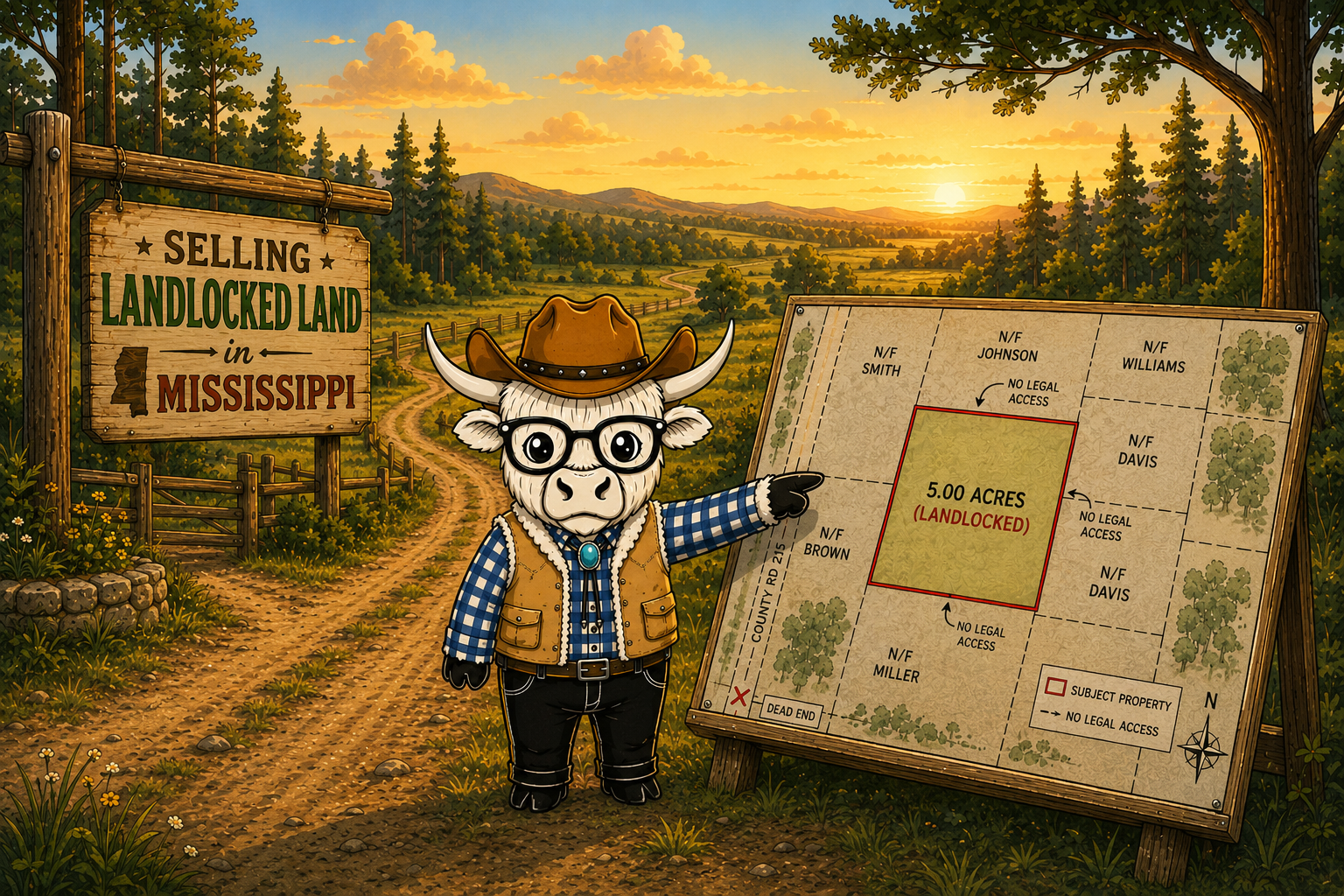
Yes — you can sell landlocked land in Mississippi, even with no legal road access. It usually sells at a discount and to a smaller pool of buyers (cash buyers, investors, and neighbors who already touch a road), but it's far from worthless. You can fix access first through an easement or the state's private-road law, or sell as-is for cash. Debrosland buys landlocked parcels as-is and closes through a real estate attorney or title company.
Figures are general 2026 estimates for orientation, not an appraisal or legal advice. Every parcel is different.
Landlocked land is a parcel with no legal access to a public road — it's surrounded by property owned by other people on every side. Most landlocked parcels are born the same way: an owner split off a piece years ago and never recorded an easement across the land in between, or an old division happened long before anyone was thinking about access.
The single most important idea here is that legal access and physical access are not the same thing. A dirt two-track your family has driven for thirty years feels like access — but if it crosses a neighbor's land and nothing was ever put on paper, then in the eyes of a buyer, a lender, or a title company, you have no access at all. That gap is what drags down the value and shrinks the buyer pool, and it's the thing worth understanding before you sell.
Pull your deed and survey. If there's no recorded easement, right-of-way, or road frontage described in writing, treat the parcel as legally landlocked when you plan your sale — even if you've been driving in for years.
In Mississippi there are four main ways to turn "no access" into recorded, marketable access. Tap each one to see how it works and where it tends to get stuck. The right path depends on your parcel's history — and how it came to be landlocked in the first place.
The cleanest option by far. You and a neighbor agree, in writing, that you can cross their land to reach a public road — and you record that easement with the county. Most Mississippi easements are created this way, by deed.
Access the law implies when your parcel has no other reasonable way out. In Mississippi this generally requires that your land and the neighboring land were once owned together and were split in a way that left yours landlocked.
Earned through long, open use of a route without the owner's permission — the access cousin of adverse possession. Mississippi uses a ten-year clock, and every element must be proven by clear and convincing evidence.
Mississippi's backstop for landlocked owners. Under Miss. Code § 65-7-201 you can petition the special court of eminent domain for a private road across a neighbor's land when it's necessary for getting in and out.
This is a plain-English overview of Mississippi access law, not legal advice. Which path fits your parcel — and how to do it right — is a conversation for a real estate attorney or title company.
There's no single number — it depends on the parcel, the location, and how hard access is to fix — but the discount is real and it's steep. Land-industry estimates in 2026 put a truly landlocked parcel anywhere from roughly half off to as little as a quarter of what the same dirt would bring with legal road frontage. Securing recorded access is usually the single biggest lever that moves the number back up.
Illustrative only — not an appraisal. A professional land appraisal typically runs about $300–$700 if you want a parcel-specific number.
Two things drive that discount. First, most banks won't finance landlocked land — a lender doesn't want to end up owning a parcel it can't resell — so cash becomes the realistic way deals get done. Second, many counties won't issue a building permit without legal access, which rules out anyone hoping to build. That's why the buyer pool narrows to cash buyers, land investors, and adjoining owners. Curious where your own parcel lands? Our guide on how much your Mississippi land is worth walks through the rest of the value picture.
When it's time to sell, landlocked owners usually weigh three paths. None is automatically "right" — it comes down to your timeline, your appetite for a fight, and what the parcel is realistically worth on each side of the access problem.
The owner next door already has road access, so your landlocked acres are often worth more to them than to anyone else. It can be the simplest deal — but only one or two people can realistically buy, so there's little competition on price, and it can take time.
Lock in a recorded easement or pursue the private-road statute first, then list with legal access in hand. This usually recovers the most value — but it can mean lawyers, surveys, neighbor negotiations, and months of uncertainty, with no guarantee a court grants what you want.
Skip the access battle entirely. A direct buyer like Debrosland will make a cash offer on the parcel as it sits, landlocked and all, and close on your timeline. You trade a piece of the upside for speed and certainty — no agent, no financing contingency, no waiting for the one buyer who's willing.
Plenty of owners take the same route they would with any parcel they're ready to let go of — see how to sell land without a realtor in Mississippi. And if the land came to you through family, the access tangle often shows up alongside title questions — our step-by-step guide for selling inherited land covers both.
"Nine times out of ten, landlocked dirt isn't a dead end — it's a paperwork problem. Get the access recorded and the value comes right back. And if you'd rather not fight that battle, that's exactly the kind of parcel we'll buy as-is for cash."
You can. Debrosland buys landlocked parcels in Mississippi as-is — we take on the access risk, the holding time, and the work of sorting it out later, which is exactly why direct buyers exist. We'll be straight with you about it: we don't pay retail, because we're a direct buyer, not a marketplace. But every offer is fair, what we quote is what you pocket because we cover closing costs, and every closing runs through a real estate attorney or title company. No agents, no listings, no waiting for the right buyer to come along.
Yes. Landlocked land is harder to sell and usually sells at a discount, but it's far from worthless. Your most likely buyers are cash buyers, land investors, and the neighbors who already touch a road. A direct buyer like Debrosland can make a cash offer and close it as-is through a real estate attorney or title company — no agent, no financing contingency, and no waiting for the one willing buyer.
It's access the law implies when a parcel has no other reasonable way out. In Mississippi it generally requires that your land and the neighboring land were once owned together and then split in a way that left yours landlocked. You don't have to prove the road is absolutely necessary — only that it's reasonably necessary for getting in and out. A court declares it after you trace that shared ownership in the chain of title.
Yes. Mississippi Code § 65-7-201 lets a landlocked owner petition the special court of eminent domain for a private road across a neighbor's land when it's necessary for ingress and egress. You have to show the parcel is truly landlocked and that you couldn't get a reasonable right-of-way from any surrounding owner. If the court agrees, you pay the neighbor's damages plus the costs of the proceeding.
It varies by parcel, but the discount is steep. Land-industry estimates in 2026 put a truly landlocked parcel anywhere from roughly half off to as little as a quarter of what the same land would bring with legal road frontage. Securing recorded access is usually the single biggest thing that moves the number back up, which is why some owners fix access before they sell.
Rarely. Most lenders won't write a loan on a parcel with no legal access, because they'd be left with collateral they can't easily resell if the loan went bad. That's a big reason landlocked land tends to sell to cash buyers and investors — and a big reason a straight cash sale or owner financing is often the realistic path to closing.
You're not required to, but access and easement issues are exactly where clean paperwork matters most. Running the sale through a real estate attorney or title company protects both sides, confirms what access (if any) is actually on record, and makes sure the deed and any easement language are handled correctly so the deal holds up later.
Landlocked, tangled title, or just ready to be done with it — send us the details and we'll come back with a fair, no-obligation cash offer. Zero closing costs, and we close through a real estate attorney or title company.
Prefer to talk it through? Call us at (970) 829-8580 or start on the Mississippi land page.
Debrosland is a land company — not a law firm, tax advisor, or financial advisor. Everything on our blog is general information to help you get your bearings, not legal, tax, or financial advice for your situation. For that, talk to a qualified professional — and run any closing through a real estate attorney or title company.
Made with in Timnath, Colorado since 2017.