Region 06 · South Central · Timber Country

Pine Belt Working land in working towns.

Family-owned land buyers since 2017. South Mississippi's Pine Belt spans 15 counties anchored by Hattiesburg and Meridian, running **$2,500–$8,000/acre** for timber and pasture. Strong forestry economy, steady residential growth. We close in 14 days, all cash, all-in.

Questions? howdy@debrosland.com · Office hours 9am–6pm Mountain
Authored by Seth & Bryce Drehle-Ewan, Co-Founders · About Debrosland
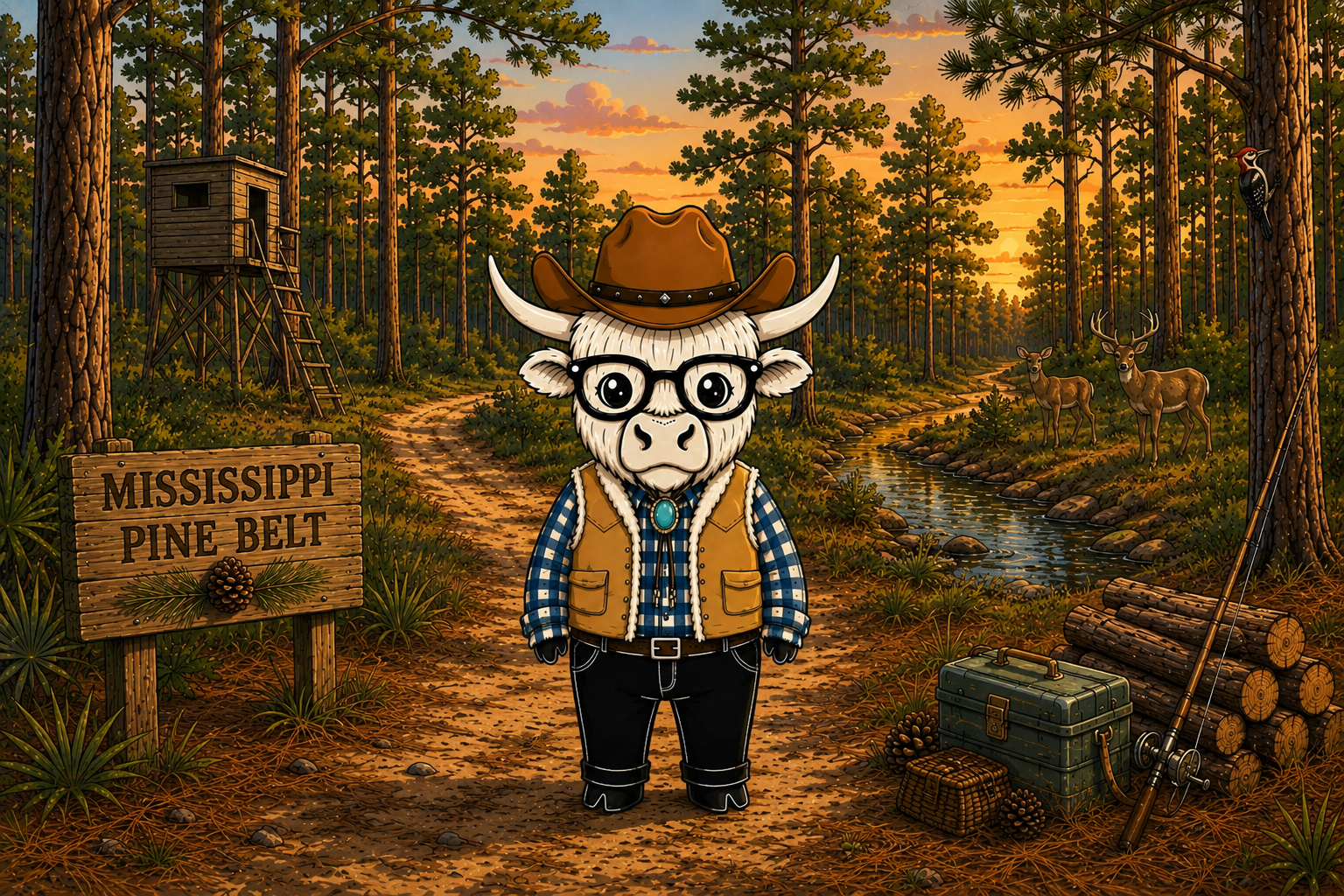
Benji the Highland Cow in Pine Belt, Mississippi
15
Counties
$2,500–$8K
Per Acre
10–400+ ac
Parcel Range
Hattiesburg
Anchor Hub

The Pine Belt is the forestry heart of Mississippi — a broad band of longleaf and loblolly pine plantation country running across the south-central part of the state. Hattiesburg (Forrest and Lamar Counties) is the regional anchor, home to the University of Southern Mississippi and the William Carey University medical campus. Laurel in Jones County is the smaller sister city — the original "Hometown" city of the HGTV show that put it on the national map. Camp Shelby, one of the largest National Guard training bases in the country, sits just south of Hattiesburg. The economy is timber, healthcare, and military. Land buyers here underwrite based on the age of the pine stand, the productivity of the soil (the "site index"), and the haul distance to the nearest mill.

We're adding new parcels in this region on a regular basis. Want a heads up about upcoming inventory before it goes live? Get in touch and we'll keep you in the loop.

Talk to us
GROUND TRUTH

The lay of the land

What the land looks like

Rolling terrain with sandy loam soils that grow pine exceptionally well. Longleaf, loblolly, and shortleaf are the dominant species. Most non-residential acreage is in some stage of pine rotation — recently planted, mid-rotation thinned stand, or pre-harvest mature timber. Hardwood draws and creek bottoms add habitat diversity.

Timber investment

The Pine Belt is one of the most active timber investment markets in the South. Pine plantations are bought, thinned, harvested, and replanted on roughly 25–35 year rotations. Buyers evaluate site index (a productivity measure — 70+ is excellent for loblolly in this region), stand age, mill distance, and access. A 40-acre pre-thinning stand at age 15 with a site index of 80 and paved-road frontage to a major mill is a different financial animal than a recently clear-cut parcel of the same size.

Hattiesburg and Laurel

Hattiesburg (population about 47,000) is the cultural and educational anchor of south Mississippi. The University of Southern Mississippi has 14,000 students, and Forrest General Hospital is the largest medical center in the region. Laurel (population about 18,000) has become a quietly hot destination thanks to the Erin and Ben Napier Hometown HGTV series — antique shopping, downtown restoration, weekend tourism. Both have growing rings of suburban land buyers.

Camp Shelby and defense

Camp Shelby Joint Forces Training Center covers about 134,000 acres south of Hattiesburg — one of the largest training installations in the country. The economic footprint of Camp Shelby and the Hattiesburg military community has been a steady employer in the region for decades.

Hunting and recreation

Whitetail and turkey hunting are reliably solid through the Pine Belt. The De Soto National Forest covers about 380,000 acres across the region — public hunting, fishing, and primitive camping. Black Creek (one of only two designated Wild and Scenic Rivers in the Southeast) cuts through De Soto and offers paddling, swimming, and undeveloped river-bottom acreage if you can find it.

What to watch for

If you're buying a pine plantation parcel as an investment, get a timber cruise — a forester's estimate of the standing volume and value — before you commit. The price difference between a stand at age 12 and one at age 18 is significant, and the cruise puts a real number on it. Mineral rights are largely intact in most of the Pine Belt but worth a title-search confirmation. Internet and cell coverage have improved substantially over the past five years.

Typical parcel sizes

Pine plantation tracts range from 20 acres up to several thousand for industrial owners. Most of our listings sit in the 20–160 acre range — large enough to manage as a small timber hold or recreational property, small enough for a single-family buyer to underwrite.

Pine Belt
HOWDY FROM

Pine Belt

Howdy from the Pine Belt! Tall longleaf, loblolly stands, Hattiesburg humming, and the smell of fresh-cut timber in the morning. If you're an investor who wants land that pays you back, you'll find it here.

At a glance

Region quick reference

Best for

timber investment, forestry, recreational land, hunting, Hometown HGTV proximity

Anchor towns

Hattiesburg, Laurel, Petal, Ellisville, Columbia

Counties

Forrest, Lamar, Jones, Covington, Jefferson Davis, Marion, Wayne, Perry, Greene, Smith, Lauderdale, Lawrence, Walthall, Clarke, Jasper

FREQUENTLY ASKED

Common questions

How much does pine plantation land cost per acre in Mississippi's Pine Belt?

Mature pine plantation pricing varies significantly by stand age and quality. A recently clear-cut parcel might run $1,800–$2,500/acre. A 12–15 year mid-rotation stand on good soil typically trades $3,000–$4,500. Pre-harvest mature timber (age 25–30+) can run $4,500–$6,500/acre depending on the standing volume. Recreational and mixed-use tracts without significant timber value usually run $2,500–$4,000/acre. Forrest and Lamar Counties (Hattiesburg area) price higher than the outer counties — Wayne, Greene, and Perry consistently run cheaper for comparable acreage.

Is timber land in the Pine Belt a good investment?

The Pine Belt is one of the most active timber investment markets in the South — the buyer pool, mill infrastructure, and 25–35 year rotation cycle are all well-established. Returns depend on site index (a soil productivity measure — 70+ is excellent for loblolly here), stand age at purchase, mill haul distance, and management quality through the rotation. Patient capital that can hold 15–20 years through a thinning and final harvest typically earns competitive returns. Short-term flips rarely work in timber. A professional forester's evaluation is essential before commitment.

What is a timber cruise and do I need one before buying Pine Belt land?

A timber cruise is a forester's estimate of the standing volume and market value of timber on a specific parcel — typically expressed in cords per acre or board feet per acre, broken out by species, stand age, and grade. Costs run roughly $1.50–$4.00 per acre depending on parcel size. For any parcel where timber is a meaningful portion of the value (which is most Pine Belt tracts), a pre-purchase cruise is essential — it puts a real number on what you're buying. Skip the cruise and you're buying on guesswork.

Can I buy Pine Belt land with owner financing?

Yes. Debrosland offers owner financing directly on every Pine Belt parcel we sell — no bank, no credit check, and closing through a real estate attorney or title company. The structure is typically a down payment plus a fixed monthly payment over a set term. Pine Belt timber and recreational tracts work well for owner financing because the buyer pool — timber investors, recreational landowners, and rural homebuilders — often prefers to skip conventional rural-land bank loans. Specific terms are posted on each listing.

What's the difference between buying near Hattiesburg vs Laurel?

Hattiesburg (Forrest and Lamar Counties) is the regional anchor — University of Southern Mississippi, Forrest General Hospital, William Carey, and the largest job base in south Mississippi. Pricing reflects the metro pull: $5,000–$10,000/acre is common on smaller suburban parcels. Laurel (Jones County) is smaller and has been quietly hot thanks to the Hometown HGTV series — antique shopping, downtown restoration, weekend tourism. Laurel pricing is more moderate, generally $3,000–$6,000/acre on comparable parcels. Both have growing suburban rings, but Hattiesburg's economic base is significantly broader.

Where can I find recreational hunting land in the Pine Belt?

The De Soto National Forest covers about 380,000 acres across Forrest, Perry, Jackson, George, Stone, and Greene Counties — public hunting, fishing, and primitive camping. Parcels adjacent to De Soto units carry a meaningful recreational premium. Whitetail and turkey hunting are reliably solid throughout the Pine Belt. Greene, Wayne, Perry, and the outer Jefferson Davis areas tend to have the most affordable hunting acreage. Black Creek (one of only two designated Wild and Scenic Rivers in the Southeast) cuts through De Soto and offers paddling, swimming, and river-bottom acreage where it can be found.

How does Camp Shelby affect the surrounding Pine Belt land market?

Camp Shelby Joint Forces Training Center covers about 134,000 acres south of Hattiesburg — one of the largest National Guard training installations in the country. The economic footprint employs a steady civilian and contracted workforce in Forrest, Perry, and adjacent counties, supporting both residential and rural acreage demand. Parcels near Camp Shelby see steady buyer interest from military families and contractors. Noise overflow from training is real but localized — your real estate attorney or title company can confirm proximity to active training zones before closing.

What's a good site index for Pine Belt loblolly investment?

Site index measures soil productivity for a specific tree species — for loblolly pine in the Pine Belt, site index 70 is good and 80+ is excellent. The number represents the projected height of dominant trees at age 25. A site index 80 stand of loblolly on a 25–30 year rotation will produce substantially more harvestable volume than a site index 60 stand on the same schedule. Forrest, Lamar, and Jones Counties have abundant site index 75–85 land. Soil productivity is the single biggest driver of long-term timber return.

TALK TO US ABOUT

Pine Belt

Owner-financed, family-run, real conversations. No banks, no credit checks. We'll tell you what's available and what's coming.