Region 03 · East · Black Prairie

Golden Triangle Three towns, one growing economy.

Family-owned land buyers since 2017. The Golden Triangle — Lowndes, Oktibbeha, Clay, and surrounding counties — runs **$3,500–$10,000/acre** for a mix of pasture, timber, and rural homesites anchored by Columbus, Starkville, and West Point. We close in 14 days, all cash, all-in.

Questions? howdy@debrosland.com · Office hours 9am–6pm Mountain
Authored by Seth & Bryce Drehle-Ewan, Co-Founders · About Debrosland
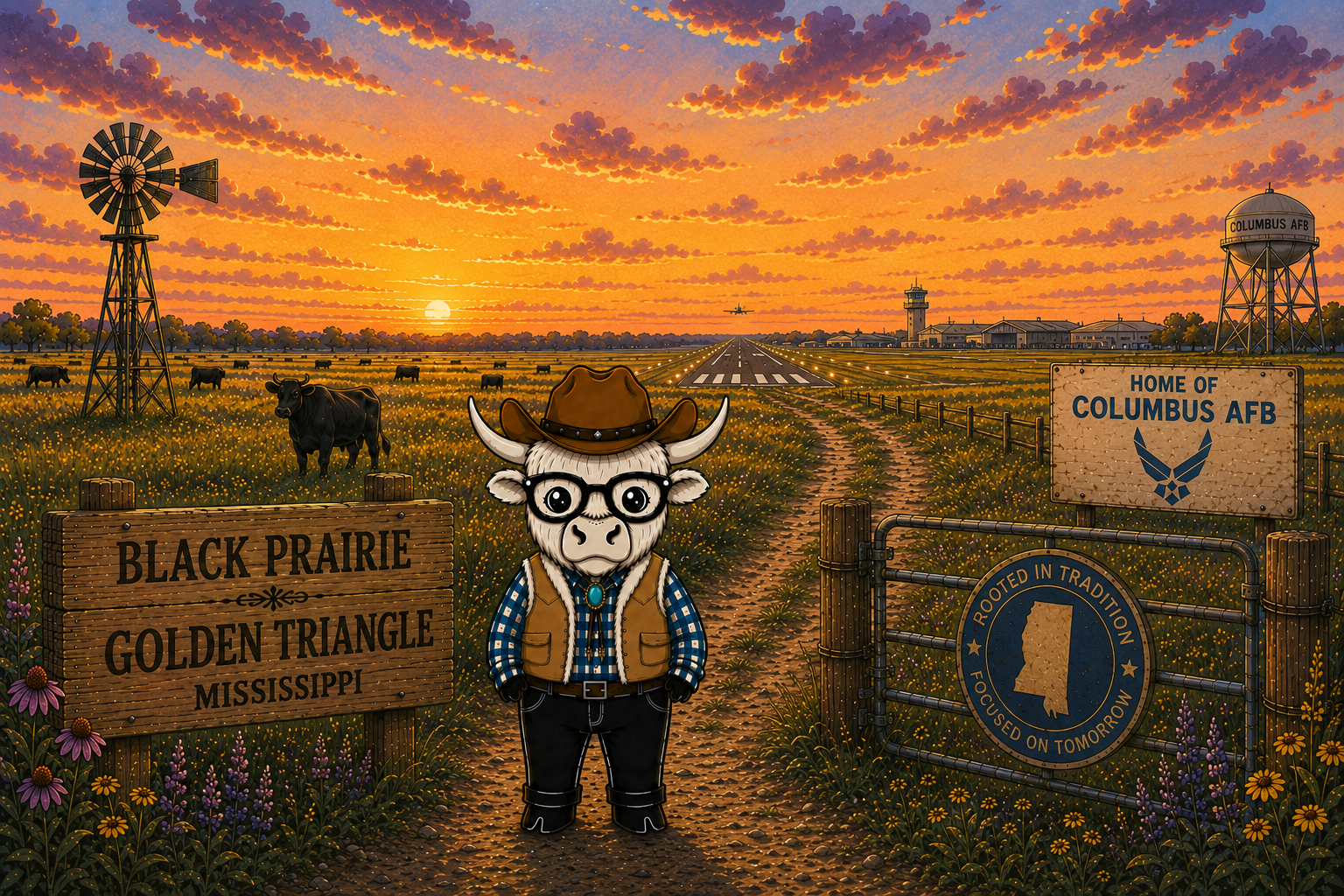
Benji the Highland Cow in Golden Triangle, Mississippi
8
Counties
$3,500–$10K
Per Acre
5–150+ ac
Parcel Range
Starkville
Anchor Hub

The Golden Triangle is the Mississippi region most people from outside the state have never heard of, and that's a shame — it's productive, lively, and increasingly one of the strongest small-metro economies in the South. Anchored by Starkville (home of Mississippi State University), Columbus, and West Point, the Triangle sits on the eastern edge of the state in the Black Belt Prairie — a band of rich, dark, alkaline soils that supports cattle, row crops, and (historically) some of the strongest farming in the South. A growing manufacturing corridor along the Tennessee-Tombigbee Waterway includes a Steel Dynamics mill, a Yokohama Tire plant, and a long-standing steel operation. Mississippi State pulls people in; the jobs keep them. Land here is well priced, well watered, and underrated.

We're adding new parcels in this region on a regular basis. Want a heads up about upcoming inventory before it goes live? Get in touch and we'll keep you in the loop.

Talk to us
GROUND TRUTH

The lay of the land

What the land looks like

The Black Belt Prairie is the defining feature — narrow on a Mississippi map but rich beyond what you'd guess. Black-soil prairie sections of dark, deep, alkaline clay good for hay, cattle, and corn. Outside the prairie band, the region rolls into mixed hardwood and pine, with the Tombigbee River corridor running north-south through the eastern side.

Mississippi State pull

Starkville is a college town in the Oxford sense — restaurants, music, a walkable downtown, football Saturdays that draw the entire state. The university is the largest employer in Oktibbeha County and one of the largest in the state. Faculty, staff, and graduate students keep a steady rental market going, and parcels within 30 minutes of campus hold their value well. Outside the city limits, prices drop fast.

Manufacturing and the Waterway

The Tennessee-Tombigbee Waterway runs the eastern edge of the region, connecting the Tombigbee to the Tennessee and providing barge access to the Gulf via the Black Warrior-Tombigbee system. That's why the Steel Dynamics mill, Yokohama Tire, and the older steel operation sit where they do. Manufacturing employment in Lowndes, Clay, and Oktibbeha Counties has held up better than most of rural Mississippi over the past decade.

Cattle and ag country

The Black Belt supports a strong cow-calf operation tradition. Smaller cattle parcels (40–200 acres) come up regularly. Hay production is meaningful — most operations here cut three times a year on improved Bermuda or bahia. If you're looking for a working small-cattle setup or a hay parcel that can carry itself, the Triangle is one of the better places in the state to shop.

Hunting and water

Whitetail hunting is solid throughout, particularly along the Tombigbee corridor. Noxubee National Wildlife Refuge in southern Oktibbeha and Noxubee Counties is 48,000 acres of public hunting, fishing, and birdwatching — old-growth bottomland hardwood and managed waterfowl impoundments. Aliceville Lake and Columbus Lake (both Tenn-Tom impoundments) provide fishing, boating, and waterfront acreage along the eastern fringe.

What to watch for

Black-soil prairie parcels can have expansive clay that shrinks and swells with moisture — a real construction consideration if you're planning a stick-built home. A geotechnical consultation is cheap insurance on prairie land. Mineral rights are largely unsevered here. Access is generally good — paved county roads on most parcels.

Typical parcel sizes

Listings range widely — 5-acre hobby parcels around Starkville and Columbus, 40–80 acre cattle and timber tracts in the prairie, and larger 100–300 acre family compound or investment tracts further out toward Noxubee County. Pricing is moderate — generally below DeSoto/Lafayette levels but above the Delta.

Golden Triangle
HOWDY FROM

Golden Triangle

Howdy from the Golden Triangle! Cattle on black prairie, Mississippi State just down the road, and Steel Dynamics bringing jobs to the corridor. This is the Black Belt — quietly one of the strongest little corners of the state.

At a glance

Region quick reference

Best for

cattle and cow-calf operations, college-town life, manufacturing-corridor jobs, mixed-use land

Anchor towns

Starkville, Columbus, West Point, Macon

Counties

Lowndes, Oktibbeha, Clay, Noxubee, Webster, Choctaw, Winston, Kemper

FREQUENTLY ASKED

Common questions

How much does Black Belt prairie land cost per acre in the Golden Triangle?

Prairie cattle and hay land in Lowndes, Oktibbeha, Clay, and Noxubee Counties typically runs $3,500–$6,500 per acre on improved pasture, with mixed timber tracts often $2,500–$4,500. The closer you get to Starkville (Oktibbeha County) or Columbus (Lowndes County), the higher the premium — sometimes $7,000–$10,000+ on smaller suburban parcels. Outside the immediate Starkville/Columbus rings, particularly in Noxubee, Winston, Webster, and Choctaw Counties, pricing drops into the $2,000–$3,500 range. Cattle operations and timber holds drive most of the larger-tract market.

Is the Golden Triangle a good place to buy cattle land in Mississippi?

Yes — the Black Belt Prairie is one of the best cattle regions in the South. The dark, deep, alkaline clay soils support strong hay production (most operations cut three times annually on improved Bermuda or bahia) and reliable cow-calf cycles. Smaller cattle parcels of 40–200 acres come up regularly. The infrastructure is in place: regional auctions in West Point and Macon, ag extension support through Mississippi State, and a working livestock economy. The Black Belt's cow-calf tradition runs deep here.

How close to Mississippi State University does land hold its value?

Within about a 30-minute drive of Starkville (Oktibbeha County), land holds its value well — faculty, staff, and graduate students keep a steady demand for both small residential parcels and rental properties. Within the 15-minute ring, pricing climbs significantly and parcels move quickly. Outside the 30-minute radius (into Noxubee, Choctaw, or Webster Counties), prices drop substantially and the buyer profile shifts toward agriculture, timber, and recreation. Football Saturdays drive a meaningful weekend economy in the immediate Starkville ring.

Can I buy Golden Triangle land with owner financing?

Yes. Debrosland offers owner financing directly on every Golden Triangle parcel we sell — no bank, no credit check, closing handled by a real estate attorney or title company. The structure is typically a down payment plus a fixed monthly payment over a set term. Owner financing suits the Golden Triangle buyer profile well: cattle operators, faculty buyers, and recreational tract buyers often prefer to skip the conventional rural-land loan process. Each listing on our site has its specific terms posted.

What construction challenges come with Black Belt prairie soils?

Black-soil prairie can have expansive clay that shrinks and swells significantly with moisture changes — this matters if you're planning a stick-built home or any concrete foundation. A geotechnical consultation before construction is cheap insurance on prairie land. Soils outside the immediate prairie band (in Choctaw, Webster, or Winston Counties) are more typical Mississippi clay loam and don't present the same expansion concern. For pole barns, ag buildings, or off-grid setups, the prairie soils are generally fine.

Is there good hunting land near the Tennessee-Tombigbee Waterway?

Yes. Whitetail hunting is solid throughout the Golden Triangle, particularly along the Tombigbee corridor. Noxubee National Wildlife Refuge in southern Oktibbeha and Noxubee Counties is 48,000 acres of public hunting, fishing, and birdwatching — old-growth bottomland hardwood and managed waterfowl impoundments. Aliceville Lake and Columbus Lake (both Tenn-Tom impoundments) provide additional fishing, boating, and recreational tract access. Hunting tracts adjacent to public-land units carry a real recreational premium.

What makes Lowndes County different from Oktibbeha or Noxubee for land buyers?

Lowndes County (Columbus) is the manufacturing and waterway anchor — Steel Dynamics, the legacy steel operation, and Yokohama Tire all sit here, supporting middle-class home and land demand. Oktibbeha County (Starkville) is the college-town anchor with Mississippi State and its associated rental and faculty market. Noxubee County is rural, agricultural, and significantly cheaper per acre — the buyer profile skews toward cattle operations, hunting, and family compounds. Each county has its own market dynamic; the Lowndes and Oktibbeha rings carry premiums, Noxubee delivers acreage for the dollar.

Is the Golden Triangle a good area for timber investment?

It's a secondary timber region behind the Pine Belt — there's pine plantation activity, particularly in Winston and Choctaw Counties, but the volume isn't comparable to south Mississippi. The Golden Triangle's land economics favor cattle, hay, manufacturing, and recreational use over pure timber investment. If timber is your primary goal, the Pine Belt is the stronger market. If you want mixed-use land that supports cattle, some pine, and recreational hunting, the Golden Triangle is a good fit.

TALK TO US ABOUT

Golden Triangle

Owner-financed, family-run, real conversations. No banks, no credit checks. We'll tell you what's available and what's coming.