
© 2026 Debrosland, LLC. All rights reserved.
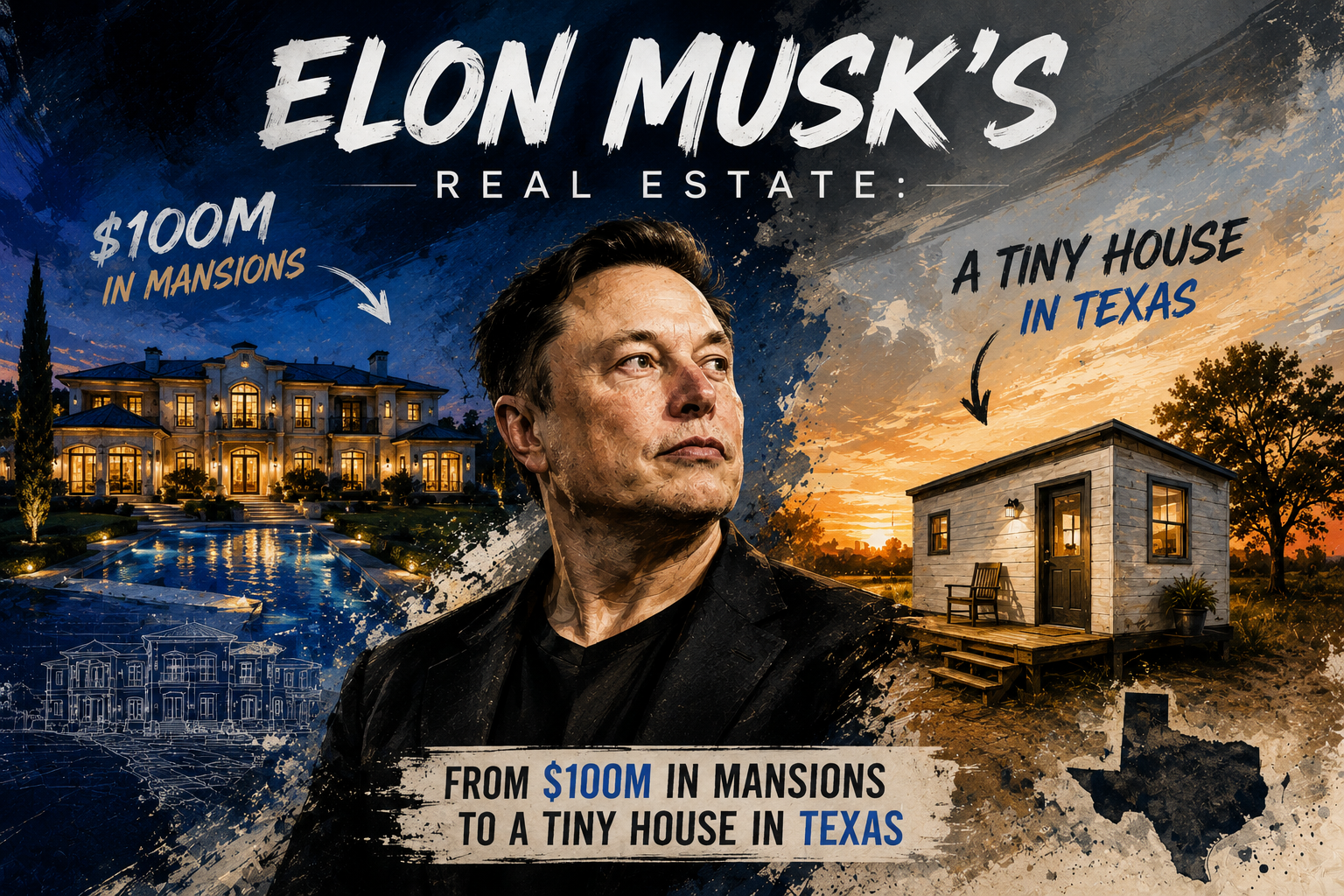
Elon Musk once owned at least seven California homes worth over $100 million. In May 2020 he vowed to "own no house," sold the portfolio off by late 2022, and now rents a roughly $50,000 home from SpaceX near Starbase, Texas. The bigger story, though, is the land — his companies now control around 6,000 acres across the state.
It's one of the most dramatic real estate pivots in modern memory: the world's richest person walked away from a nine-figure mansion collection and into a rented house the size of a studio apartment. But the popular "billionaire downsizes to a $50K box" headline leaves out the more interesting half of the story — what he kept buying, and why it was land. Here's the full arc, fact-checked, and what an everyday buyer can actually take from it.
Tap through the arc — it's stranger, and more deliberate, than the headlines suggest:
Starting around 2012, Musk assembled at least seven properties in and around Bel Air, Los Angeles. The anchor was a roughly 16,000-square-foot, seven-bedroom mansion he'd rented since 2010 and bought for about $17 million. In 2013 he added the former home of actor Gene Wilder — turning it into a private school called Ad Astra rather than living in it. By 2017 he'd also bought a century-old, 47-acre estate in Hillsborough near San Francisco for $23.4 million. At its peak the portfolio was worth an estimated $100 million-plus.
On May 1, 2020, Musk posted: "I am selling almost all physical possessions. Will own no house." Asked why, he replied: "Freedom." Within days two of his Bel Air homes hit the market, and more listings followed — part of a broader push to shed possessions he'd described as "an attack vector."
Musk listed four Bel Air properties as a single $62.5 million bundle and sold them about six months later. The Gene Wilder house went to the actor's nephew for around $7 million, with a covenant that it could never be torn down or lose its character — and Musk reportedly lent the buyers the money to do it. The last to sell was the Bay Area estate, which closed in late 2022 for about $32 million. The mansions were gone.
By now Musk's center of gravity had shifted to South Texas. In May 2025, residents around SpaceX's Boca Chica launch site voted to incorporate as the official city of Starbase, Texas — with Musk himself a registered voter there. A launch facility had, in effect, become a municipality.
Musk lives small personally — but his companies don't. By a 2025 Houston Chronicle analysis, entities tied to Tesla, SpaceX, and The Boring Company control more than 500 properties across roughly 6,000 acres of Texas — including Tesla's 2,500-acre Austin Gigafactory, Starbase, and Snailbrook, a planned company town near Bastrop with sub-market rental homes for employees.
"I am selling almost all physical possessions. Will own no house."
Sort of — but not the way the headlines suggest. In June 2021 Musk wrote that his "primary home is literally a ~$50k house in Boca Chica / Starbase that I rent from SpaceX." He rents it; he doesn't own it. He has also owned a Boxabl Casita — a $49,500, 375-square-foot foldable prefab — but he's said he uses it as a guest house and denied living in the tiny home itself.
He does own one mid-sized house in Austin, and in 2024 there were reports of roughly $35 million in Austin-area property tied to housing his children, which Musk publicly disputed as a "compound." And in a twist on "own no house," he reportedly even began foreclosing on that $7 million Gene Wilder home after the buyers he'd financed defaulted. The tidy "billionaire lives in a $50K box" story is real in spirit — messier in the details.
You don't need a Musk-sized fortune to take something real from this story:
Musk sold every mansion he owned but kept buying land — thousands of acres in Texas. Buildings age and depreciate; well-located land in the path of growth tends to appreciate.
His Texas land sits next to his own companies' operations, in a no-income-tax state. The everyday version: land near expanding towns, new infrastructure, or growing employers tends to outperform.
A mansion is a mansion. A parcel can become a homestead, a weekend retreat, a rental, a future build, or simply a long-term hold — part of why land has drawn investors for centuries.
Musk works at an extreme scale, but affordable parcels exist nationwide. States like Mississippi and Colorado sell land at a fraction of California prices, often with owner financing.
"The lesson isn't 'sell your house.' It's that land and buildings behave differently as assets — Musk shed the mansions and kept buying dirt in the path of growth. You can apply the same thinking with a few acres, not a few hundred million."
Mostly yes, with nuance. Musk's primary residence is a roughly $50,000 home he rents from SpaceX near Starbase (Boca Chica), Texas — he rents it rather than owning it. He owns a Boxabl foldable prefab he's said he uses as a guest house, and denied living in the tiny home itself, plus one mid-sized house in Austin.
In May 2020 he announced he would "own no house," saying physical possessions were a distraction — "an attack vector" — and, when asked why, simply replied "Freedom." The moves also freed up liquidity for his companies and let him live close to SpaceX's launch operations in Texas.
At its peak, his collection of at least seven California homes was worth an estimated $100 million-plus, with some estimates putting it around $130 million. Key pieces included a roughly $17 million Bel Air mansion, the former Gene Wilder home, and a $23.4 million estate in the Bay Area.
Primarily in a rented roughly $50,000 home near Starbase (Boca Chica), Texas, steps from SpaceX's launch site, which became an incorporated city in May 2025. He also owns a mid-sized house in the Austin area.
By a 2025 Houston Chronicle analysis, entities tied to Musk's companies control more than 500 properties across roughly 6,000 acres of Texas — valued at an estimated $3.4 billion for tax purposes by The Real Deal. The holdings include Tesla's 2,500-acre Austin Gigafactory, Starbase, and the Snailbrook development near Bastrop.
Snailbrook is a planned company town on land near Bastrop, Texas, developed by Musk's Boring Company and SpaceX to house employees in sub-market rental homes — reported around $800 a month — alongside amenities like a bodega, pub, and recreation. The name nods to Boring's goal of building machines that outpace a snail.
Sources: Musk's "own no house" announcement and home listings — CNN Business (2020); Texas land holdings (500+ properties, ~6,000 acres) — The Real Deal / Houston Chronicle (2025); $3.4 billion tax-value estimate and Snailbrook — CRE Daily; the rented $50K home and Boxabl guest-house clarification — Musk's own posts on X (2020, 2021) and reporting by Business Insider.
Browse affordable parcels in Mississippi and Colorado — many with owner financing — or get a fair cash offer on land you already own. We make both sides simple, fast, and fair.
Questions? Call (970) 829-8580 or email howdy@debrosland.com. New to the terms? See our land dictionary or the five ways to buy land.
Debrosland is a land company — not a law firm, tax advisor, or financial advisor. Everything on our blog is general information to help you get your bearings, not legal, tax, or financial advice for your situation. For that, talk to a qualified professional — and run any closing through a real estate attorney or title company.
Made with in Timnath, Colorado since 2017.